 Back to homepage
IKKE-STATS TEORI
NON-STATE THEORY
The Ibsen Year 2028 is the national 200th anniversary of Henrik Ibsen's birth. On this occasion, we have updated the report:
The individualist anarchist Henrik Ibsen and his "Non-State" Theory.
The Non-State Theory of the individualist anarchist Henrik Ibsen was well known in the anarchist section of the People's Movement against the EU (Folkebevegelsen mot EU) in 1994, after having been published in Folkebladet, the Peoples' Journal, no. 4 1981. This Non-State Theory was one of several sources of inspiration for a clear NO to the EU in 1994 and especially the actions following up the result of the referendum by Faxes sent to CNN and more from AIT/AIIS. See: The history of Norway and the Anarchy - https://www.anarchy.no/a_nor.html. We thank Henrik Ibsen for this theory. Here we will place Henrik Ibsen's Non-State Theory into a larger context of the history of anarchism in Norway.
Some time has passed on since the Norwegian People turned their back against the main economic political course of the marxist social democrat government, at the 1994 EU referendum. This was an anarchist "bottom - up" from the People, i.e. the grassroots, revolutionary change - against the Authorities, i.e. the Bureaucracy, broadly defined in both public and private sector. The "top - down" management of Gro Harlem Brundtland & Co. was crushed, and Norway became an Anarchy, i.e. of low degree. The megatrend of the late eighties and early nineties was a movement to the right and upwards on the Economical Political Map. The EU referendum and more actions indicated a further jump in this direction, and thus the economic political system in Norway made a revolutionary change, and passed the border between the marxist social democrat sector and the anarchist, i.e. liberal social-democratic - sector of social individualism. This of course is a major social event in the economic political world history. A long jump further rightwards may result in a liberalist system, and a reverse tendency may give a retardation to marxist social democracy, but this is not the case at the moment. Thus, Norway became an anarchy in 1994/95, and it still is an anarchist economic-political system, i.e. real democracy = liberal social democracy with a significant green tendency.
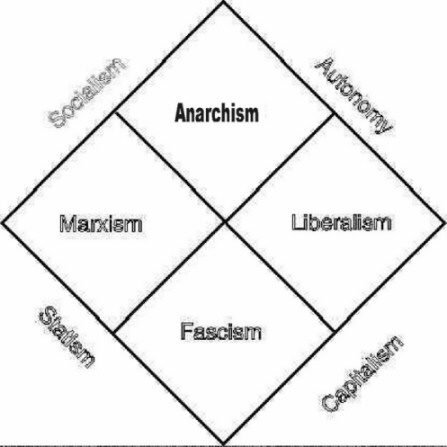
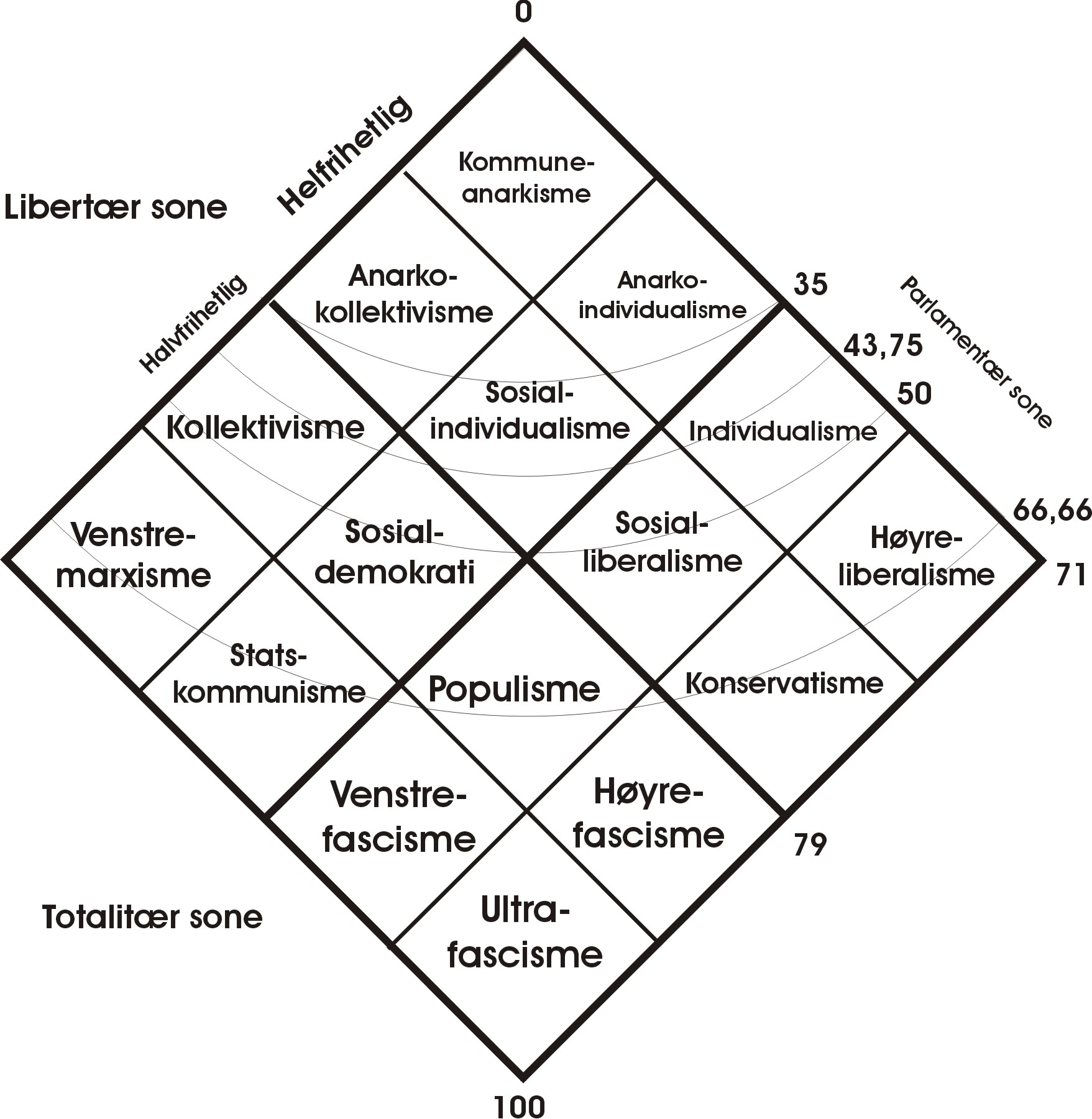
The Economic-Political Map
 "
"
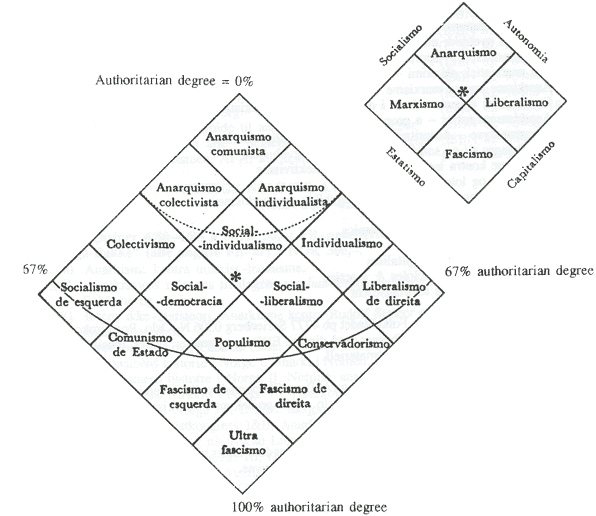
The Economic-Political Map
The anarchy degree is 100% - the authoritarian degree within the anarchist quadrant. "Esquerda" means left, and "direita" means right.
The star indicates the Norwegian economic-political system after the velvet anarchist revolution in 1994/95. The anarchist ideal, i.e. real democratic ideal, is at the top of the map.
We use the term semi-libertarian for all systems that are not totalitarian and are not anarchist.
Henrik Ibsen and his Non-State Theory have their place on the economic-political map in the Anarchist quadrant and the sector of Anarcho-individualism, close to Individualism.
He is a completely libertarian (frihetlig) person, and is therefore not semi-libertarian.
And thus, the Anarchy of Norway is still going strong. Although the system is significantly anarchist, i.e. within the Quadrant of Anarchism on the economic political map, it is somewhat far from the anarchist i.e. real democratic ideal on the top of the map. "So this is heaven: Norway", the LA-TIMES in USA reports about Norway, November 2001, but this is however a bit exaggerated; see American look at Norway - Report no 1, where the article is quoted, with comments from IIFOR added. Another American article on the situation in Norway, quoted from NY-TIMES January 2002, also with comments from IIFOR, is also included.
The main policy of the Anarchist International (AI/IFA) and The Anarchist Federation of Norway (AFIN) was presented in the largest Newspaper in Norway, Verdens Gang 06.11.2001, p 39, see Anarchy is [real] democracy - article in VG. This article also states "Norway [as] a relatively anarchist country, however a bit far from the anarchist ideal (Norge som et relativt anarkistisk land, men nokså langt fra det anarkistiske ideal)."
In June 2002 a libertarian direct action against the World Bank's reactionary policy and the ABCDE-meeting, in Oslo, once more confirmed that anarchy is significantly on in Norway, see Direct action against the ABCDE-meeting and policy. Norwegian firms are more and more horizontally organized, according to Nordhaug and Gooderham at NHH (Dagsavisen 15 & 16.10.2004).
A degree of anarchism of ca 54%, as in Norway 2025 is as mentioned not a high degree of anarchism. This means the authoritarian degree is still ca 46%. If the libertarian degree is less than 50% there is no anarchy, i.e. real & green democracy, at all. About 54% anarchy degree is quite an accepted estimate. It is a.o.t. quoted in Dagens Næringsliv (the Industrial life of today, the main economical newspaper of Norway) no 2/3 June 2007 and Finansavisen (the Financial newspaper) Wednesday 17. October 2007, see anarchist articles in DN and Finansavisen.
30.05.2007. The Anarchy of Norway was rated as the most peaceful nation in the world, and since the middle of 1995 the country has also been ranked as the most democratic, libertarian and anarchist on planet Gaia, a.k.a. Tellus and Earth.
15.01.2010. Positive citizen survey: A nationwide citizen survey shows that 86 per cent of Norwegians think that their country is close to being a perfect country to live in.
02.11.2011. Flat hierarchy challenges new leaders. Norway's "flat, flat, flat" management hierarchy [i.e. not topheavy pyramid economically and/or political/adminstrative] poses a huge challenge for new leaders recruited from overseas. It can also explain why there's so few of them within the Norwegian business world. "Many leaders can feel so disrespected when they come to Norway," said Kimberly Lein-Mathisen, global alliance leader for the large US pharmaceutical company Eli Lilly. Everyone is equal, and employees are accustomed to being consulted on most matters, and having their say. Source: www.newsinenglish.no.
So called heaven or not, 54% anarchism is far from the 100% anarchist ideal, full democracy. Thus, it is plenty of room for improvement from anarchist & real democratic = liberal social democratic, perspective, and by no means time for a break in the fight against authoritarian tendencies. The revolution must be fought permanent, in the daily life, to sustain and develop further. However, as long as a) Norway stays out of EU, b) populist and nationalist tendencies are put at place, and c) the left and right tendencies outbalance each other reasonable as by now, Norway will probably stay anarchist and real & green democratic, liberal social democratic, and be a lighthouse for EU and the rest of the world. We call for anarchist, real & green democratic Bottom – Up actions to sustain and increase the degree of anarchy and democracy in Norway!
The Real & Green Democracy revolution in Norway and the Green Global Spring Revolution GGS. The veteran eco-anarchist and anarcha-feminist Anna Quist from the Anarchy of Norway, is elected as the official spokesperson for the GGS. She was elected 28.09.2019 unanimously by the GGS/AI- secretariat in Oslo, the capital of Norway, a country in Northern Europe, and an Anarchy (of low degree) since the velvet anarchist revolution 1994/95, also with a significant green tendency. A.o.t. there is no significant coal problem in this country. The revolution started 28.11.1994 with the EU-referendum and more actions. The Anarchy of Norway is still going strong, and in 2019 The 25th anniversary of the anarchist revolution in Norway was celebrated world wide by Real and Green Democrats Thursday 28. November, the Day of the Anarchist Revolution in Norway. "The Real and Green Democracy Revolution in Norway is a significant inspiration for The Green Global Spring Revolution (GGS) because it demonstrates fully that 1. Anarchy, i.e.liberal social democracy including a significant green tendency, works, and 2. that the GGS may very well succeed world wide! But not without hard work and using all legal means and actions!" said Anna Quist, a 1. veteran Real and Green Democracy, i.e. Anarchist, activist since 1965, also 2. activist in the Norwegian anarchist, including green, revolution in 1994/95 and later, and 3. now and in the future official spokesperson for The Green Global Spring Revolution (GGS).
JENS HERMUNDSTAD ØSTMOE ALIAS TIMIAN SABATINI FRA FABS - KORT HISTORIKK OM FORHOLDET TIL ANARKISTBEVEGELSEN.
Jens ble født i desember 1948 og allerede i 1964 hadde han frihetlige idéer i tilknytning til bandet sitt, som i 1965 fikk navnet FABS, siden kjent som det Føderalistiske Anarkistiske Beat Sambandet. I 1968 var Jens primus motor i arbeidet med FABS-filmen «Monter» og Kultursyndikatet. I 1977 var han blant initiativ makerne til dannelsen av Anarkistføderasjonen i Norge, ANarkistenes ORGanisasjon (AFIN/ANORG). Han har også blitt angrepet av og har sloss med nynazister, noe som går fram av et intervju med Østmoe i en artikkel i ukebladet Vi Menn, Nr. 27 – juli 1979. Han var også aktiv i fløyelsrevolusjonen i 1994/95, som gjorde Norge til et Anarki (av lav grad). Fra og med 1996 var han en vesentlig bidragsyter til Folkebladet/anarchy.no samtidig som han var primus motor i NØI-INDECO-OSE/indeco.no. Jens har vært aktiv til dags dato i en alder av 77 år (født 21.12.2948). Og fortsetter. Han har skrevet artikkelen om Henrik Ibsens Ikke-stats teori i Folkebladet fra 1981.
JENS HERMUNDSTAD ØSTMOE ALIAS TIMIAN SABATINI FROM FABS - BRIEF HISTORY OF THE RELATIONSHIP TO THE ANARCHIST MOVEMENT.
Jens was born in December 1948 and already in 1964 he had libertarian ideas in connection with his band, which in 1965 was named FABS, since known as the Federalist Anarchist Beat Society. In 1968, Jens was the prime mover in the work with the FABS film "Monter" and the Culture Syndicate. In 1977, he was among the initiators of the formation of the Anarchist Federation in Norway, ANarkistenes ORGanisasjon (AFIN/ANORG). He has also been attacked by and has fought with neo-Nazis, which is clear from an interview with Østmoe in an article in the weekly Vi Menn, No. 27 – July 1979. He was also active in the Velvet Revolution in 1994/95, which turned Norway into an Anarchy (of a low degree). From and including 1996, he was a significant contributor to Folkebladet/anarchy.no at the same time as he was the prime mover in NØI-INDECO-OSE/indeco.no. Jens has been active to date at the age of 77 (born 21.12.1948). And continues. He wrote the article about Henrik Ibsen's Non-State Theory in Folkebladet from 1981.
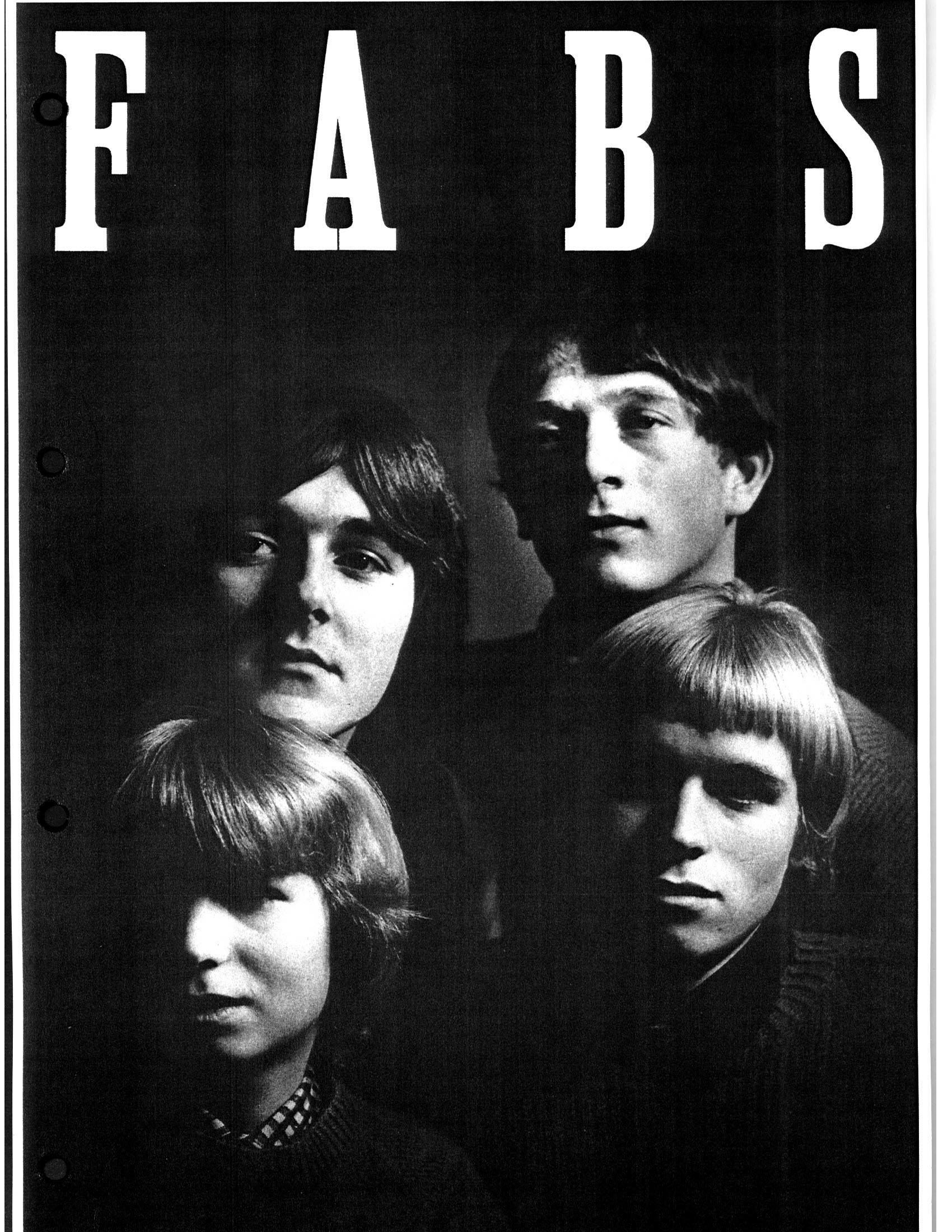
FABS ANNO 1967
ARCADIAN MUSIC PRODUCTION
JENS HERMUNDSTAD ØSTMOE ALIAS TIMIAN SABATINI NEDERST TIL HØYRE.
JENS HERMUNDSTAD ØSTMOE ALIAS TIMIAN SABATINI BOTTOM RIGHT.
Henrik Ibsen's anarkistiske dikt "Til Min Venn Revolusjonstaleren" med bakgrunnsmusikk fra FABS og lest av Jens Hermundstad Østmoe alias Timian Sabatini er omtalt på FABS' Hjemmeside:
Henrik Ibsen's anarchist poem "To My Friend the Revolutionary Orator" with background music from FABS and read by Jens Hermundstad Østmoe alias Timian Sabatini is featured on FABS' Website:
FABS - Det Føderalistiske Anarkistiske Beat Sambandet - Homepage - English and Norwegian texts, With links - playlists - to their 5 main albums on YOUTUBE and more.
Diktet inngår som en av låtene til FABS' monumentale album: "Anarki i Norge - Anarchy in Norway" som omhandler anarkismens historie i Norge. Link til albumet er følgende:
The poem is included as one of the songs on FABS' monumental album: "Anarki i Norge - Anarchy in Norway" which deals with the history of anarchism in Norway. The link to the album is as follows:
Låten "Den Første Anarkismebølgen" som bl.a. inneholder Ibsen's dikt "Til Min Venn Revolusjonstaleren" finner du på følgende link:
The song "The First Anarchist Wave" which includes Ibsen's poem "To My Friend the Revolutionary Speaker" can be found at the following link:
https://www.youtube.com/watch?v=98UP-HD-bA4&list=OLAK5uy_nQAaOcG9zc7n3KtfWgryN_Mpz_ILClLrQ&index=3
Det anarkistiske (= liberale sosial-demokratiske) idealet - anarkistenes (de liberale sosial-demokratenes) langsiktige økonomisk-politiske mål!
AI-generated video about the 100% anarchist = real democratic, ideal. Click on: http://www.anarchy.no/anarchistideal.mp4
Det anarkistiske idealet er generelt et samfunn såvidt mulig innrettet etter anarkistiske prinsipper, som en ledestjerne for den økonomisk-politiske styringen m.v.. Prinsippene for det anarkistiske idealsamfunnet er: 100% sosialisme og autonomi i vid forstand, effektivitet (Pareto-optimalitet, også med hensyn på miljøfaktorer) og rettferdighet (ombyttekriteriet, at ingen vil bytte posisjon med noen annen, når alt kommer til alt), minimale rangs- og lønnsforskjeller - politisk/administrativt og økonomisk hierarki, herunder frihet (uten andres frihets berøvelse, slaveri og tyranni), likhet, solidaritet; sosial justis inklusive libertær (frihetlig) lov (vedtatt direkte av folket selv eller via delegater) og optimal orden, rettssikkerhet og menneskerettigheter, frie kontrakter (ikke slavekontrakter), frie initiativer, ateisme (anarkismen er et sekulært prosjekt, men innebærer full religionsfrihet), antimilitarisme (basert på gjensidig nedrustning og styrkebalanse), internasjonalisme (ikke overnasjonalisme, eller nasjonalisme), desentralisme, selvstyre og føderalisme (ikke hierarkisk, EU-aktig), selvforvaltning (autogestion) og frihetlig kommunalisme, dvs. beslutninger tas i hovedsak lokalt av de vesentlig og konkret berørte - fra enhver etter evne - til enhver i følge behov. Dette er essensen av «system og styring uten hersker og hersking» = an-ark-i. Dvs. reelt demokrati.
Den vanlige venstre vs. høyre dimensjonen alene er fullstendig utilstrekkelig til å gi et tilstrekkelig bilde av det økonomisk-politiske landskapet. Det todimensjonale økonomisk-politiske kartet som presenteres her gir et adekvat bilde av det økonomisk-politiske landskapet.
Frihet, det vil si graden av frihet, måles ved libertær-graden = 100 % - autoritær-graden. Den libertære graden = graden av demokrati. Frihet, er frihet uten å skade andres frihet, ikke frihet for andres regning, økonomisk og/eller politisk/administrativt, i vid forstand! Reell frihet = eller > 50 % libertært & demokratisk, dvs. både økonomisk og politisk/administrativ i vid forstand = anarki og anarkisme. Virkelig frihet = eller > 50% sosialisme & autonomi bredt definert = anarki og anarkisme. Reelt demokrati inkluderer alltid grønn politikk, det vil si betydelig. Ekte demokrati betyr at samfunnet skal styres og drives fra bunnen og opp, det vil si fra Folket – grasrota, og oppover, ikke fra toppen – ned, det vil si betydelig. Dette er ekte føderalisme. Dette er frihet i et samfunnsperspektiv.
The anarchist (= liberal social-democratic) ideal - the long-term economic-political goal of the anarchists (the liberal social-democrats)!
AI-generated video about the 100% anarchist = real democratic, ideal. Click on: http://www.anarchy.no/anarchistideal.mp4
The anarchist ideal is generally a society organized as far as possible according to anarchist principles, as a guiding star for the economic-political management, etc. The principles for the anarchist ideal society are: 100% socialism and autonomy in the broadest sense, efficiency (Pareto-optimality, also with regard on environmental factors) and justice (the exchange criterion, that no one will exchange positions with anyone else, after all), minimal rank and salary differences - political/administrative and economic hierarchy, including freedom (without deprivation of others' freedom, slavery and tyranny), equality, solidarity; social justice including libertarian (freedomly) law (adopted directly by the people themselves or via delegates) and optimal order, rule of law and human rights, free contracts (not slave contracts), free initiatives, atheism (anarchism is a secular project, but implies full freedom of religion), antimilitarism (based on mutual disarmament and balance of forces), internationalism (not supranationalism, or nationalism), decentralism, self-government and federalism (not hierarchical, EU-like), self-management (autogestion) and libertarian communalism, i.e. decisions are mainly taken locally by the significantly and concretely affected - from anyone according to ability - to anyone according to need. This is the essence of "system and governance without a ruler and ruling" = an-arch-y. That is real democracy.
The usual left vs. the right dimension alone is completely insufficient to provide an adequate picture of the economic-political landscape. The two-dimensional economic-political map presented here gives an adequate picture of the economic-political landscape.
Freedom, i.e. the degree of freedom, is measured by the libertarian degree = 100% - the authoritarian degree. The libertarian degree = the degree of democracy. Freedom, i.e. freedom without harming others' freedom, not freedom at others expence, economically and/or political/administrative, in the widest sense! Real freedom = or > 50% libertarian & democratic, i.e. both economic and political/administrative in the widest sense = Anarchy and Anarchism. Real freedom = or > 50% socialism & autonomy broadly defined = Anarchy and Anarchism. Real democracy always includes green policy, i.e. significant. Real democracy means society should be managed and run from the bottom up, i.e. from the People – grassroots, and upwards, not from the top – down, i.e. significant. This is real federalism. This is freedom in societal perspective.
Anarki = An-Ark-I betyr system og styring uten hersker(e), An = uten, Ark = hersker og I = system og styring, som i monark-i.
Det betyr ikke at systemet er uten topp og øvrighet, men at innflytelsen på styringen både politisk/administrativt og økonomisk, går mer nedenfra, fra Folket, grasrota, enn fra toppene, ovenfra og ned.
Anarchy = An-Arch-Y means system and governance without ruler(s), An = without, Arch = ruler and Y = system and governance, as in monarch-y.
It does not mean that the system is without a top and authority, but that the influence on governance, both politically/administratively and economically, comes more from below, from the People, the grassroots, than from the tops, from the top down.
Some time has passed on since the Norwegian People turned their back against the main economic political course of the marxist social democrat government, at the 1994 EU referendum. While the Norwegian EEC referendum in the early seventies gave a movement to the left on the economic political map, the megatrend of the late eighties and early nineties was a movement to the right and upwards. The EU referendum and more actions indicated a further jump in this direction, and thus the economic political system in Norway made a revolutionary change, a "bottom - up" revolution, and passed the border between the marxist social democrat sector and the anarchist, i.e. liberal social-democratic, sector of social individualism. This of course is a major social event in the economic political world history.
A long jump further rightwards may result in a liberalist system, and a reverse tendency may give a retardation to marxist social democracy, but this is not the case at the moment, and thus the living Anarchy of Norway (AoN), a liberal social democratic and real & green democratic system, is still going strong.
Although the system by now is significantly anarchist, i.e. within the Quadrant of Anarchism = the Quadrant of Liberal Social Democracy, on the economic political map, it is somewhat far from the anarchist ideal on the top of the map, i.e. full democracy. Thus, it is plenty of room for improvement from anarchist perspective, and by no means time for a break in the fight against authoritarian tendencies. The revolution must be fought permanent, in the daily life, to sustain and develop further. However, as long as a) Norway stays out of EU, b) populist and nationalist tendencies are put at place, and c) the left and right tendencies outbalance each other reasonable as by now, Norway will probably stay anarchist, liberal social democratic, and real & green democratic, and be a lighthouse for EU and the rest of the world.
Let's work together, on co-operative or individual basis, in media, political and economic organizations, to support the Anarchy of Norway and anarchist - liberal social democratic, and real & green democratic - tendencies all over the world. Here Henrik Ibsen's "Non-State-Theory" may be a source of inspiration...
SOME OF THE HISTORY OF NORWAY
AND ABOUT HENRIK IBSEN AND HIS NON-STATE THEORY
The modern history of Norway as an independent country, started with the breakaway revolution from the Union with Sweden, triggered by the 07.06.1905 declaration. This revolution was based on a referendum. Of 435 375 persons who had the right to vote, 85,4 % participated, and only 184 voted for the Union. A civil war was avoided because Norway was well armed, and the Swedish workers threatened with a revolutionary general strike, if the liberation was not accomplished.Several hundred years ago Norway was also an independent land. A long time ago a democratic tendency with municipal and regional tings, i.e. some kind of more or less direct democratic councils, where all free men or delegates met and decided regulations and regulatory means, made judging and sometimes even deciding ways to elect as well as sack a king, may be mentioned. Thus, an egalitarian as well as libertarian tendency and culture have a long historical tradition in Norway.
However in the meantime, before 1905, Norway was de facto a vassal state, ruled from Sweden, Denmark or Germany (Hansa). Henrik Wergeland (1808-45) was influenced by the somewhat social individualist libertarian tendencies of those days, writing a.o.t.: "Hør mig, Despot! Jeg være vil din Pestilents mens jeg er til! Om Nordamerikaneren: Gid rastløse Flid vi af Yankeen lærte! Men ei vil vi have en Dollar til Hjerte. Om Franskmanden. Vi ham taknemmelig maa hylde. Vor Frihed vi Revolutionen skylde." (Source: HENRIK WERGELAND - SAMLEDE SKRIFTER IV. AVHANDLINGER, OPPLYSNINGSSKRIFTER 7. BIND: 1844 - 1845, p.235, 255 and 256). Thus he declared to be a life long plague against tyranny, would not have a US $ as a heart, and had a sound freedom and revolution on the agenda, inspirited by the French people. He also had ideas similar to Pjotr Kropotkin and later Ragnar Frisch, that a combination of practical work, say gardening, and theoretical work, was an optimal basis for human development. By the way, Henrik Wergeland was a lawful person using a colorful language, and that he would act as a 'plague to authority' must of course not be interpreted literary, as a defence for biological weapons, spreading illnesses, or something like that.
ABOUT HENRIK IBSEN AND HIS NON-STATE THEORY - OM HENRIK IBSEN OG HANS IKKE-STATS TEORI
In 1850 the 22 year old Henrik Ibsen (1828-1906) used the play "Catilina" (1850) to promote the anarchist ideal about fairness and freedom without violence, investigated in a societal context, universally and individually, probably inspirated by P. J. Proudhon, according to Max Nettlau and Erik M. Christensen. Works of Proudhon were published in the journal of the early workers' movement, "Thranittene", with Marcus Thrane in the forefront, a man that in 1851declared that P. J. Proudhon was vor tids uden tvivl største sjeni, the "with no doubt greatest genius of our time", although Thrane probably did not understood the genius too well, interpreted it a bit wrong, and partly rejected anarchism. The young Ibsen participated actively in this movement. When later asked why he wrote about Catilina (a nobleman and pretor), Ibsen replied that his, i.e. not the historical, Catilina, was an anarchist. The "Non-State-Theory" (Ikke-stats-teori) of Henrik Ibsen, called so by himself in one of his private letters, "min fortræffelige stats-teori - eller rettere ikke-stats-teori!" (quoted from Ibsens's letter to Georg Brandes 18.05.1871, after the fall of the Paris Commune), and revealed in several letters many of them later published in a book called "Breve" (1904), is also a contribution to libertarian ideas, in addition to anarchist elements in his plays and poems. It is also quite clear from the available documents known today, that Ibsen's "Non-State Theory" seen all in all was mainly libertarian individualistic, and not liberalistic, and thus Ibsen must be accounted for as a significant individualist anarchist, at least in a part of his grown up life, if not all. Although Henrik Ibsen did not explicitely called himself an anarchist publicly, his "Non-State-Theory" etc. clearly show he was within the libertarian (frihetlige = anarkistiske) tradition, i.e. as an individualist anarchist. The libertarian ideas of Henrik Ibsen was thus not close to the ideal form of anarchism, 90%-100% degree of anarchy, but to the right in the sector of individualist anarchism on the economic-political map.
17 February 1871 Henrik Ibsen wrote to Georg Brandes: "The state is the individual's curse. The state must go! I will be part of that revolution. Undermining the concept of the state, set up volunteerism and the spiritually related as the one decisive factor for an association, - that is the beginning of a freedom, which is worth something. Changing forms of government is nothing more than a puzzle with degrees, a little more or a little less, - badness all in all." In 1871, Ibsen also had the famous anarchist poem "Til min ven revolutionstaleren" published. (BY HENRIK IBSEN. COPENHAGEN. PUBLISHED BY DEN GYLDENDALSKE BOGHANDEL (F. HEGEL). THIELES BOGTRYKKERI. 1871. To my friend the revolution speaker!) In 1872, the followers of Ibsen formed the first, informal, early beginnings of the Anarchist Federation in Norway. A small individual-anarchist movement. Historians Penny A. Weis and Megan Brueske write in their book Feminist Manifestos from 2018: "The Anarchist Federation of Norway dates back to 1872." But the anarchist organization did not gain real momentum until the 1880s. Henrik Ibsen was often referred to in his time as an anarchist because of his strong emphasis on individual freedom and critical attitude towards state power. Although he never explicitly called himself an anarchist, he did not object to the label "anarchist" either.
"As one of the founders of modernism in theatre, Henrik Ibsen is often referred to as “the father of realism” and is one of the most influential playwrights of all times. In the 19th century, the playwright Henrik Ibsen completely rewrote the rules of drama by introducing a form of realism that we still see in theatres today. He turned the European stage away from what it had become – a plaything and distraction for the bored – and introduced a new type of moral analysis. Ibsen brought his audience into ordinary people’s drawing rooms, where the bourgeois kept their carefully guarded secrets. He then pitted the conflicts that arose from challenging assumptions and direct confrontations against a very realistic middle-class background and developed his plays with piercing dialogue and meticulous attention to detail. For this, he has earned his place in history. Ibsen is undoubtedly one of the greatest playwrights in the universe. So naturally, The International Astronomical Union named a planet after him. Only a minor planet, but still! “If you take away the average man’s life-lie you take away his happiness at the same time.”– From The Wild Duck.
Henrik Ibsen’s major works include Brand, Peer Gynt, An Enemy of the People, and A Doll’s House, as well as Hedda Gabler, Ghosts, The Wild Duck, When We Dead Awaken, and The Master Builder. All of these plays have strong and challenging characters that live on in the audience's imagine outside of their plays’ intrigues. A Doll’s House is perhaps the most-staged of Ibsen's plays. The third act culminates in the character of Nora leaving her husband Torvald and her three children – unheard of in 1879, when it was first performed, and still one of the most famous gender political moments in world literature. The role of Nora even holds an iconic status: Unesco’s Memory of the World register calls Nora “a symbol throughout the world, for women fighting for liberation and equality”." Source: Visitnorway.com.
HENRIK IBSEN'S NON-STATE THEORY- HENRIK IBSENS IKKE-IKKE STATS TEORI
Fra Folkebladet Nr. 4. 1981
Translation tool Norwegian to English, French, German, Spanish, Arabic, Russian, Chinese etc., and vice versa: Google Translate.
Ingress
Forfatteren Henrik Ibsen kjenner vi alle, men de politiske ytringene hans har vært lite framme i vinden. Ibsen karakterisere sine politiske idéer som "ikke-stats teori".
Den foreligger bare i bruddstykker, hovedsakelig i private brev, men vi har forsøkt å utrede den så godt det lar seg gjøre ved å sitere fra disse kildene.
"Ikke-statsteorien" har interesee ikke bare fordi den kaster lys over Ibsens diktning, men også fordi den tar opp problemfelter i anarkistisk teori, for eksempel forholdet mellom den bevisste minoritet og massene og den kulturelle revolusjon.
Og sist, men ikke minst, er det viktig å få den fram i lyset fordi det står lite til ingenting om den i leksikalske oppslagsverker, noe som bidrar til å skape et fordreid og borgerlig-gjort bilde av Ibsen
Ibsen var ikke [ideal, 90-100% anarkigrad = 90-100% frihetlig] anarkist. Han brukte aldri denne betegnelsen om seg sjøl så vidt vi kjenner til.
Og vi vil ikke i ettertid på autoritært vis trykke ham ned i en bås som han sjøl avsto fra å stille seg i [han var altså ikke ideal-anarkist, men han kan som nevnt over likevel plasseres i den anarkistiske kvadranten
på det økonomisk-politiske kartet, i sektoren får anarko-individualisme, nær individualismen.]
Men "ikke-statsteorien" ligger nær opptil [ideal-] anarkismen og hører så absolutt til den frihetlige [dvs. anarkistiske] norske tradisjonen, vel verdt et studium.
NB! Dette alt for strenge kriteriet, at bare personer som selv hadde brukt betegnelsen «anarkist» om seg selv skulle bli godtatt som anarkister/frihetlige, skyldtes først og fremst at populistene Bertram Dybwad Brochmann og Rudolf Steiner ble feilaktig forsøkt lansert som anarkist-guruer, selv om de aldri hadde kalt seg anarkister/frihetlige, av henholdvis kretsen rundt bladet Krana og Kaj Skagen. Dette ville ikke ANORG vite noe av. Vi ville ikke ha populistisk infiltrasjon i anarkistbevegelsen.
Men dette kravet ble forlatt noe senere, da bl.a. personer som hadde gått inn for det tredje alternativ, = anarkismen - på det økonomisk-politisk kartet, også ble regnet som anarkister, selv om de ikke hadde brukt betegnelsen anarkist om seg selv.
PS. In 1886 Arne Garborg publicly expressed his anarchist point of view in the poem "Anarchist song", published in "Fedraheimen", i.e. "Our Fathers' Home", (according to Jack Wilson in 1968). Arne Garborg, Rasmus Steinsvik and Ivar Mortenson Egnund declared themselves as anarchists in 1887, according to "Fedraheimen", volum 1890, p. 50. "Fedraheimen" got the subtitle "Anarkist-Kommunistisk Organ", and thus became the first Norwegian publicly declared anarchist organ. The last issue of "Fedraheimen" was published in 1991. Mortenson Egnund in 1897-98 published "Fridom, tidsskrift for sjølstyre og sjølvhjelp" (Freedom, journal of autonomy and self-aid). In 1898 Arne Garborg wrote an article "Henrik Ibsen, tuktemeister og byggmeister" stating that Ibsen was an anarchist, and explaining what kind of anarchist he was. Ibsen did not raise objections to this. But he expressed it was wrong to interprete too much politics into his poems and plays, and rejected to be a member of the feminist movement. Thus, following Ibsen himself, we should probably concentrate mostly on his letters and other material, not the plays and poems, when investigating Ibsen's anarchism. Garborg's article about Henrik Ibsen was later printed in the "For Folkeoplysning - Tidsskrift for boksamlinger og folkeakademier", i.e. "For enlightenment of the people - Journal for public libraries and people-academies" - at Ibsen's 100 years anniversary in 1928, and thus made Ibsen's anarchism well known throughout the country at that time.
In 1891-92 a few Germans, i.e. Theodor Martner, Sigmund Simons and Wilhelm Zöllner, made anarchist propaganda in Christiania (Oslo) and established the anarchist-communistic group "Libertas"(Anarkistisk-Communistisk Gruppe "Libertas"). The Norwegians Christopher Hansteen, Axel Bech, Lorentz Nybø, Petter Nilsen, Rasmus Steinsvik, Sigwald Lian, and Ole O. Lian also joined this group. "Libertas" was the first publicly declared anarchist group in Norway. Hansteen was editor of the paper "Anarkisten". Hans Jæger and Henrik Ibsen may also be accounted for as anarchists, especially Ibsen, although in some of their works perhaps being more spokesmen for collectivism and individualism, respectively. Say, Max Nettlau mentions Ibsen for "strong individualism" and Folkebladet/IJ@'s brief history of Anarchism in Norway, 1. edition, mentions a clear marxist type dialectical tendency in some of Jæger's works, i.e. not anarchist and strongly authoritarian.
Hans Jæger's position as the strong leader of "Kristianiabohemen", a group with a policy that was not anarchist at all, - earlier - confirms his authoritarian tendency ("Fra Kristiania-Bohêmen" by Hans Jæger, 1985). Kristianiabohemen was an authoritarian socialist group, marxist on the economic-political map. The policy was strongly against the farmers and against the anarchist Henrik Ibsen. The group had about 20-30 members at its peak around 1885. Hans Jæger was not an anarchist at that time. He first read about anarchism in France in 1892, and later worked for the social-democratic marxist paper "Social-demokraten" from 1898. It was first later he became more of an anarchist, and issued "Anarkiets Bibel" in 1906.
A referendum in 1905 was about the question of republic. 439 716 persons had the right to vote, 75,3 % participated, and 78,9 % voted for a powerless king, instead of, perhaps, a powerful president. Thus, the symbolic king of Norway was introduced by a referendum. "Libertas" made an active anarchist campaign both outside and within the new "sosialistiske ungdomslag", socialist youth federations, that started about 1900. In 1903 some of them associated to a national confederation. This youth confederation was however a weak organization, and splitted in three in 1909, according to Arbeidernes Leksikon, p. 900. Hansteen died in 1906 and Sigwald Lian in 1909, at that time businessmanager of the organ of the youth confederation. He contributed to the publishing of anarchist material until he died. The other members continued the work for anarchism and federalism and against centralism and marxism, and Axel Bech in 1925 wrote an article about Hansteen in "Alarm", the syndicalist paper. Also Hans Jæger and Swedish libertarian immigrants and refugees made anarchist information. Jæger's 489 pages work "Anarkiets Bibel" was as mentioned published in 1906, but the book had both anarchist, and strong marxist type dialectical tendencies, and thus it neither became a "bible" on anarchism nor for anarchists. Jæger died in 1910.
By the way, Harald Fagerhus has a three-page chapter (pages 88-90) on Ibsen's "non-state theory" in the Appendix on "Anarchism and syndicalism in Norway about 1850 - 2000" published in IJ@ 2/05 (35) About the northern and southern sections of IFA-IAF and the Anarchist International AI-IFA-IAF - https://www.anarchy.no/ija235.html. J-HØ.
Translation tool Norwegian to English, French, German, Spanish, Arabic, Russian, Chinese etc., and vice versa: Google Translate.
IBSENS IKKE-STATS-TEORI
Norske Anarkisters Utredninger (NAU) – Nr. 3
Publisert av Folkebladet i nr 4 - 1981.
Ibsen regnet seg ikke sjøl til noen av datidens politiske retninger. Han skriver: "Det er blevet en naturnødvendighed for mig at arbejde fuldt selvstendig og følge min egen kurs." Han skulle ønske at man ikke hadde glemt at "jeg aldrig hadde tilhørt og sandssynligvis aldrig vilde tilhøre noget som helst parti. Jeg vil stå...enlig...ude ved forposterne og operere på eget hånd." En kan merke seg at i datidens og Ibsens egen språkbruk, betyr "parti" nærmest en "gruppe meningsfeller", og ikke bare politisk-parlamentariske valgorganisasjoner.
Sitt forhold til arbeiderbevegelsen avklarer han kontant: "Med selve arbeiderbevegelsen hadde jeg egentlig intet at skaffe. Men... av alle stander i vort land er det arbeiderstanden, som står mitt hjerte nærmest." Han poengterer at "jeg ikke tilhørte det sosialdemokratiske parti". De frisinnede radikale gruppene inklusive "Bohempartiet" hvor Hans Jæger (som forfattet "Anarkiets bibel") stod sentralt, fikk også passet sitt påskrevet... "de gruppen inklusive 'Bohempartiet'" gav mig et verdifuldt bidrag til vore fremskridtsmænds karakteristikk. Aldrig har jeg følt mig mere fremmed ligeoverfor mine norske landsmænds Thun und Treiben...", skriver Ibsen etter at vennen Georg Brandes kom i tottene på "bohemerne" på en 1.maifest. "Men jeg opgiver alligevel ikke håbet om, at denne rå midlertidighed engang skal klarne sig til et virkelig kulturinnhold i en virkelig kulturform".
Men Ibsen hadde enda mindre til overs for det tradisjonelle venstrepartiet, det konservative høyre, bønder og prester. "jeg begriber ikke, hvorfor man kalder vore venstremænd liberale. Når jeg læser stortingsforhandlinger er det mig i bøndenes tankegang ikke mulig at spore en snus mere af virkelig frisindsfriheden, end den, der findes hos den ultramontane bondebefolkning i Tyrol..., liberalisterne er frihedens værste fjender. Og hvad skal man si disse om den såkaldte liberale presses forhold. Disse førere som taler og skriver om frihed og frisind, og som samtdig dermed gør sig til trælle af abonnenternes formodede meninger".
Om Høyres fremste ideolog, Stuart Mill, skriver Ibsen: "Jeg vil da ærlig tilstå Dem, at jeg aldeles ikke kan forstå, at der skal ligge noget fremskrift eller nogen fremtid i den Stuart Millske retning. Der kan være nedlagt såre megen skarpsindighed i et sligt skrift, men ...hvis dette er videnskab, så er "den kristelige etik" også et videnskabeligt værk". Og kristenfolket levnes ikke mye håp: "...avsvekkelse af dømmekraften... ialfald for gennemsnitsnaturens vedkommende, er en nødvendig følge af længere tids syslen med teologiske studier. Jeg tror vor nuværende regering lægger en altfor utilbørlig stor vægt på opinionen blandt prestefordummelsens ofre rundt omkring i landet". Ibsen har i det hele tatt ikke mye til overs for den republikanske stat, og enda mindre til overs for "prøyser-diktatur", den sterke monolittiske statstype. "Jeg ynder ikke republikken" skriver han, og mener til og med at kongemagten kan være gunstigere, "fordi den respekterer en folkestemning." Og han holdt seg langt unna Preussen, som hadde "købt... statstyrke... med individernes opgåen i det politiske og geografiske begrep."
Ibsens ideal var et "ikke-stats"-samfunn basert på frivillig sammenslutning av "åndelig beslektede", kulturnasjonene, på tvers av de gamle stats og landegrensene.
I det følgende har vi latt Ibsens egne ord stå alene, stort sett i kronologisk rekkefølge, men redaksjonen står ansvarlig for mellomtitlene og for utvalget av sitater.
Om Rom (1865 red.anm.) er det umuligt at skrive, man kan beskrive den, men det bedste, det, hvortil intet sidestykke findes, får man ikke med. Alt er uhyre her, men en ubeskrivelig fred over altsammen. Ingen politik, ingen handelsånd, intet militærvesen giver sit ensidige præg til befolkningen, den kan ikke meget og véd ikke meget, det er sikkert, men den er ubeskrivelig skøn og hel og sand og stille.
Læg hertil ... samlivet med den sorgløse kunstnerverdenen, en tilværelse, som ikke kan sammenlignes med noget andet en stemningen fra Shakespeares "As you like it"...
...hernede er jeg ikke ræd for nogenting, hjemme var jeg ræd, når jeg stod inde i den klamme flok og havde følelsen af deres stygge smil bagved mig... et folk, hvis opgave er at blive Englændere istedetfor mennesker. Det forekommer mig ofte som noget trøstesløst at arbejde i en tid som den nuværende ...vi har intet at samle os om, ingen stor sorg, således som Danmark har, thi vort folk savner den løftelse i sjælen, som kræves for at kunne sørge. Statens undergang vilde for vore folk stille seg som det værste, men en stats undergang kan ikke være genstand for sorg, og betydningen af nationens undergang føler de ikke.
–den livsgerning ...står for mig som den vigtigste og fornødneste ...at vække folket og bringe det til at tænke stort.
Venner er en kostbar luksus, og når man sætter sin kapital på en kaldelse og en mission her i livet, så har man ikke råd til at holde venner. Det kostspielige ved at holde gode venner ligger jo ikke i, hvad man gør for dem, men hvad man af hensyn til dem undlader at gøre. Derved forkrøbles mange åndelige spirer i en. Jeg har gennemgået det, og derfor har jeg bag mig en del år, hvori jeg ikke nåede frem til at blive mig selv.
Så har man da nu taget Rom (1870 red.anm.) fra os mennesker og givet det til politikerne. Hvor skal vi nu hen? Rom var det eneste fredlyste sted i Europa, det eneste sted, der nød den sande frihed, friheden for det politiske frihedstyranni. Jeg tror ikke, jeg vil gense det, efter hvad der er passeret. Alt det dejlige, umiddelbare, smudset, vil nu forsvinde, for hver en statsmand, som opstår dernede, vil der gå en kunstner tilgrunde. Og så den herlige frihedstrang, – den er nu forbi, ja, jeg må i al fald sige, at det eneste, jeg elsker ved friheden, er kampen for den, besiddelsen bryder jeg mig ikke om.
Verdensbegivenhederne optager forøvrigt en stor del af mine tanker. Det gamle illusoriske Frankrig er slået istykker, når nu også det nye faktiske Preussen er slået istykker, så er vi med et spring inde i en vordende tidsalder. Hej, hvor idéerne da vil ramle rundt omkring os. Og det kan sandelig også være på tide. Alt det vi til dato lever på, er jo dog kun smulerne fra revolutionsbordet i forrige århundrede, og den kost er jo dog nu længe nok tygget og tygget om igen. Begreberne trænger til et nyt indhold og en ny forklaring. Frihed, lighed og broderskab er ikke længer de samme ting, som de var i salig guillotinens dage. Dette er det, som politikerne ikke vil forstå, og derfor hader jeg dem. De mennesket vil kun specialrevolutioner, revolutioner i det ydre, i det politiske o.s.v. Men alt sligt er pilleri. Hvad det gælder er menneskeåndens revoltering, og der skal De være en af dem, som går i spidsen.
Jeg går aldrig ind på at gøre friheden ensbetydende med politisk frihed. Hvad De kalder frihed, kalder jeg friheder, og hvad jeg kalder kampen for friheden, er jo ikke andet end den stadige, levende tilegnelse af frihedens idé. Den, der besidder friheden anderledes end som det efterstræbte, han besidder den dødt og åndløst, thi frihedsbegrebet har jo dog det ved sig, at det stadig udvides under tilegnelsen, og hvis nogen under kampen bliver stående og siger, nu har jeg den, – så viser han derved, at han netop har tabt den. Men netop denne døde sidden inde med et visst givet frihedsstandpunkt er noget karakteristisk for statssamfundene, og det er dette jeg har sagt ikke er af det gode.
Ja, vist nok kan det være et gode at besidde valgfrihed, beskatningsfrihed, o.s.v., men for hvem er det et gode? For borgeren, ikke for individet. Men det er aldeles ingen fornuftnødvendighed for individet at være borger. Tvertimod. Staten er individets forbandelse. Hvorden er Preussens stats-styrke købt? Med individernes opgåen i det politiske og geografiske begreb. Kellneren er den bedste soldat. Og på den anden side Jødefolket, menneskeslægtens adel. Hvorved har det bevaret sig i isolation, i poesi, trods al råhed udenfra? Derved, at det ikke har havt nogen stat at trækkes med. Var det forblevet i Palæstina, vilde det for længe siden være gået under i sin konstruktion, ligesom alle andre folk.
Staten må væk! Den revolution skal jeg være med på. Undergrav statsbegrebet, opstil frivilligheder og det åndelig beslægtede som det ene afgørende for en sammenslutning, – det er begyndelsen til en frihed, som er noget værd. Ombytning af regeringsformer er ikke andet end pusleri med grader, lidt mere eller lidt mindre, – dårlighed altsammen.
Ja, kære ven, det gælder blot, ikke at lade sig skræmme af hævdens ærværdighed. Staten har sin rod i tiden, den vil faa sin top i tiden. Der vil falde større ting end den, al religion vil falde. Hverken moralbegreberne eller kunstformerne har nogen evighed for sig. Hvor meget er vi i grunden forpliktet til at holde fast ved? Hvem borger mig for at ikke 2 og 2 er fem oppe på Jupiter?
...jeg anser Frankrigs nuværende ulykke for den største lykke, der kunde times denne nation. (17. februar 1871, red.anm.)
Er det ikke nederdrægtigt af "Communen" i Paris, at den har gået hen og fordærvet mig min fortræffelige stats-teori – eller rettere ikke-stats-teori! Nu er idéen ødelagt for lange tider, og jeg kan ikke engang anstændigt fremsætte den på vers. Men den har sin kerne i sig, det ser jeg så klart, og engang vil den nok blive praktiseret uden al karrikatur. –
(18. mai 1871, etter Pariskommunens fall, red. anm.)
Hvad De skriver er mere digte end breve, det kommer til mig som et nødråb fra en, der er bleven ene levende tilbage i et stort uddød strøg...Det forekommer mig, som om De nu står i den samme krise som jeg i de dage, jeg sked til at skrive "Brand", og jeg er viss på, at også De vil vide at finde det lægemiddel, som driver sygdomsstoffet ud af kroppen.
En energisk produceren er en fortræffelig kur. Hvad jeg først og fremst vil ønske Dem er en rigtig fullblods egoisme, der kan drive Dem til for en tid at sætte Deres eget som det eneste, der har værd og betydning, og alt andet som ikke eksisterende. Optag ikke dette som et tegn på noget brutalt i min natur! De kan jo dog ikke gavne Deres samfund på nogen bedre måde, end ved at udmynte det metal, De har i Dem selv.
Specialformer lover jeg mig intet af. Hele slægten er på vildspor, det er sagen. Eller er der virkelig noget hold i den nuværende situation? Dette med uopnåelige idealer og sligt? Hele rækken af slægter forekommer mig som en ung mand, der har forladt sin læst og er gået til teatret. Vi har gjort fiasko både i elskerfaget og i det heroiske fag, det eneste, vi har vist en smule talent for, er det naiv-komiske, men med den mere udviklede selvbevidsthed går heller ikke det længere. At det er bedre bevendt i andre lande, end hjemme, tror jeg ikke, massen står uden al forståelse af det højere både ude og hjemme.
Den liberale presse lukker sig for Dem. Ja, naturligvis! Jeg udtalte engang for Dem min foragt for den politiske frihed. Kære ven, liberalisterne er frihedens værste fjender. Under absolutismen trives åndstriheden og tankefri-heden best, det viste sig i Frankrig, senere i Tyskland og nu i Rusland. (4. april 1872, red. anm.)
Hvad nu agitationen imod Dem angår, løgnene, bagvaskelserne, o.s.v., da skal jeg give Dem et råd, som jeg af egen erfaring véd er probat. Vær fornem! Fornemhed er det eneste våben imod sligt. Se lige ud, svar aldrig med et ord i aviser, hvis De i Deres skrifter polemiserer, så ret aldrig polemiken mod dette eller hint bestemte angreb, lad Dem aldrig mærke med, at et eneste ord af Deres fjender har bidt sig fast i Dem, kort sagt, træd op som om De slet ikke anede, at der var nogen modstand. Og hvad livskraft tror De vel Deres modstanderes attentater har? ...tror De det ormædte vil kunne stå imod!...hvad der ikke kan bære tidens idéer, det må falde.
Hvad der kommer ud af denne kamp på kniven imellem to epoker, det véd jeg ikke, alt andet heller, end det bestående, det er for mig det bestemmende. Af sejren lover jeg mig ikke egentlig nogen stabil forbedring: al udvikling har hidtil ikke været andet end en slingren fra den ene vildfarelse over i den anden. Men kampen er god, frisk, sund.
Jeg hører, De har stiftet en forening. Stol ikke ubetinget på enhver, der slutter sig til Dem: hovedsagen er, om tilslutningen finder sted på de afgørende præmisser. Hvorvidt Deres position styrkes derved, véd jeg heller ikke, for mig står det i al fald at den ensomme er den stærkeste. Men jeg sidder her nede i ly, og De står deroppe midt ude i uvejret, det forandrer meget.
Jeg kan ikke komme bort fra den tanke, som jeg udtalte forinden... – nemlig at De beviser størstedelen af Deres modstanderes alt for megen ære, når De nedlader Dem til at føre et forsvar...det vordendes sag...forsvarer sig selv, når man blot giver tid...Svenskerne står i visse henseender i udvikling tilbage for os andre skandinaver, men netop derved står de nærmere det kommende, thi vort forspring er for dem et forspring ind på en afvej.
Hvorfor står De og vi andre, der befinder oss på et europæisk standpunkt, så isolerede hjemme? Fordi vort hjem ikke er nogen hel sammenhængende statsorganisme, fordi man her hjemme tænker og føler og anskuer kommunalt, ikke nationalt, ikke skandinavisk. Den politiske organisation lægger jeg ikke så stor vægt på, men så meget mere på en sammenarbejdelse af vore nationalopfatninger. De kalder Deres tidsskrift "Det 19de århundrede", men hvor forskelligt fysiognomi har ikke dette samme århundrede for øjeblikket i Danmark, i Sverige og i Norge? Og tror De at denne brøkdel af europæisme, som hver af vore folkegrene sider inde med, kan afgive noget tilstrækkeligt grundlag for alt det, som De vil have ført frem? Kun de hele nationer kan være med på en kulturbevægelse. En frontforandring i livs- og verdensopfatningen er ikke nogen kommunalsag, og vi Skandinaver er, ligeoverfor Europa, endnu ikke kommen ud over sognerådsstandpunktet. Men intetsteds giver et sogneråd sig af med at forvente og fremme "det tredje rige".
Men det forekommer mig meget tvilsomt, hvorvidt det vil lykkes at få vor gode norske befolkning rusket op og reformeret stykkevis, det forekommer mig tvilsomt, om det hos os er gørligt at skaffe bedre kunsttilstande tilveje, så længe ikke den åndelige jordbund i alle retninger grundig opryddes og renskes og skaffes afløb for alt det sumpede.
Så længe en befolkning holder det for vigtigere at bygge bedehuse end teatre, så længe den er beredvilligere til at understøtte Zulumissionen end kunstmuseet, så længe kan kunsten heller ikke påregne nogen sund trivsel, ja ikke engang anses for nogen øjeblikkelig nødvendighed.
Jeg tror ikke, det hjælper langt at tale kunstens sag med argumenter, hentede ud fra dens egen natur, der hos os endnu så lidet forstås eller vel endog grundig misforstås.
Hvad der hos os først og fremst må til, er at slå ned for fode og grundig udrykke al den mørke middelalderlige munkedom, som indsnæver betragtningen og fordummer sindene. Min mening er: foreløbig nytter det ikke at bruge sine våben for kunsten, men imod det kunstfjendtlige. Få først dette ryddet afvejen, så kan vi bygge.
Begreberne om den literære ejendomsret var i vore lande dengang, ligesom tildels endnu, kun højst ufuldstændigt udviklede. Hverken regering eller storting havde sørget for at sikre de norske forfattere – og navnlig dramatikerne – mod vilkårlige indgreb af hvilkensomhelst udenforstående. Med andre ord, lovgivningen tillod ikke, i lighed med andre statsborgere, selv at nyde frugterne af vort eget arbejde. Senere har man rigtignok affundet sig med at betale et beløb efter forgodtbefindende, en fremgangsmåde, som vi endog med tak måtte finde os i.
Jeg begriber ikke, hvorledes nogen i vor tid kan føle sig såret ved at man om ham antager, at han gør fordring på at kunne leve af, hvad han lever for. Det er ganske betegnende, at i vort land blev det madnyttige vildt beskyttet ved lov, forinden digterne blev det.
Jeg får mere og mere bekræftelse på, at der ligger noget demoraliserende i at befatte sig med politik og i at slutte sig til partier.
Under alle omstændigheder vil jeg aldrig kunne slutte mig til et parti, som har majoriteten for sig. Bjørnson siger: majoriteten har altid ret. Og som praktisk politiker må man vel sige det. Jeg derimod må nødvendigvis sige: minoriteten har altid ret. Selvfølgelig tænker jeg ikke på den minoritet af stagnationsmænd, som er aktørudsejlet af det store mellemparti, der hos os kaldes de liberale, men jeg mener den minoritet, som går foran der, hvor flertallet endnu ikke er nået hen. Jeg mener, retten har den, som er nærmest i pakt med fremtiden.
Når jeg tænker på, hvor træg og tung og sløv forståelsen er derhjemme, når jeg lægger mærke til, hvor lavtliggende den hele betragtingsmåde viser sig at være, så overkommer der mig et dybt mismod, og jeg synes mangen gang, at jeg ligeså gerne straks kunde afslutte min literære virksomhed. Hjemme behøver man egentlig ingen digterværker, man hjælper sig så godt med "Stortingstidenden" og "Luthersk Ugeskrift". Og så har man jo partibladene. Jeg har ikke noget talent til at være statsborger og heller ikke til at være ortodoks, og hvad jeg ikke føler talent for, det afholder jeg mig fra.
For mig er friheden den højeste og første livsbetingelse. Hjemme bekymrer man sig ikke stort om friheden, men kun om friheder, nogle eller nogle færre, alt efter partistandpunktet. Højst pinlig føler jeg mig også berørt af dette ufærdige, dette almueagtige i vor offentlige diskussion. Under sine sore priselige bestræbelser for at gøre vort folk til et demokratisk samfund, er man uforvarende kommet et godt stykke på vej med at gøre os til et plebejersamfund. Sindets fornemhed synes at være aftagende hjemme.
(franctireur-friskytter, red.anm.)
Jeg står selv til ansvar for hvad jeg skriver, jeg og ingen anden. Jeg kan umulig genere noget parti, thi jeg tilhører ikke noget sådant. Jeg vil stå som en enlig franctireur ude ved forposterne og operere på egen hånd.
Er det da bare på det politiske felt at frigørelsesarbeidet skal være tilladt hos os? Er det da ikke først og fremst ånderne, som trænger at frigøres? Slige trælelsjele som vi kan ikke engang nytte de friheder, vi allerede har. Norge er et frit land befolket af ufrie mennesker.
Jeg fastholder, at en åndelig forpostfægter aldri kan samle et flertal omkring sig. Om ti år står måske flertallet på det standpunkt, hvor dr. Stockmann stod under folkemødet. Men i disse ti år er jo doktorens idéer bleven stående stille, han står fremdeles mindst ti år længere fremskudt end flertallet: flertallet, massen, mændene indhenter ham aldrig, han kan aldrig få flertallet omkring sig. For mit eget personlige vedkommende fornemmer jeg i al fald en sådan uophørlig fremadskriden. Hvor jeg stod, da jeg skrev mine forskellige bøger, der står nu en temmelig kompakt mængde, men jeg selv er ikke der længer, jeg er andetsteds henne, længere fremme, som jeg håber.
(særeie for gifte kvinner, red.anm.)
Havde stortingsmajoriteten med ærlig interesse sluttet sig til Berners forslag, så havde de ikke sendt forslaget til betænkning af formandskaberne. De havde overhovedet ikke æsket nogen erklæring fra mændene, men fra kvinderne. Af spørge mændene til råds i en slig sag er det samme som at spørge ulvene, om de ønsker øgede beskyttelsesmidler til fordel for saueflokkene.
Å nej, den minoritet i vort folk, som sidder inde med de politiske, kommunale og sociale privilegier, slipper dem nok ikke godvillig ud af hænderne eller deler dem med den uprivilegerede majoritet. Sligt noget gives ikke til skænk af indehaverne, det må erobres. Og allerhelst hos os, hvor afgørelsen er i hænderne på en del af landalmuen.
Derfor er jeg svare ræd for at det har lange udsigter med de sociale reformer oppe hos os. Visst nok kan de politisk privilegerede lægge sig til en eller anden ny rettighed, en eller anden ny fordel. Men jeg ser ikke at det hele store folk, og navnlig den enkelte i dette, vinder noget mærkbart derved. Men jeg er jo rigtignok en hedning også på det politiske område, jeg tror ikke på politikens frigørende magt, og på magthavernes uegennyttighed og gode vilje stoler jeg heller ikke meget.
Kunde jeg få det, som jeg vilde ha det derhjemme, så skulde alle de uprivilegerede slå sig sammen og stifte et stærkt, resolut og pågående parti, hvis program skulde være rettet udelukkende på praktiske og produktive reformer, på en meget rummelig udvidelse af stemmeretten, regulering af kvindernes stilling, folkeundervisningens frigørelse fra alskens middelalderligheder o.s.v. De teoretisk-politiske spørgsmål kunde gerne hvile en stund, de er ikke synderlig produktive. Kom et sådant parti istand, vilde det nuværende venstreparti snart vise sig at være, hvad det i virkeligheden er og ifølge sin sammensætning må være – et centrumsparti.
Men nu er her ikke plads til flere kandestøberier...
I Norge vilde det være mig rent umuligt at slå ned for alvor. Intet steds vilde jeg føle mig mere hjemløs end deroppe. For et nogerlunde åndsudviklet menneske strækker ikke nultildags det gamle fedrelandsbegrep til.
Vi kan ikke længere lade os nøje med det statssamfund, som vi sorterer under.
Jeg tror, at den nationale bevidsthed er i ferd med at uddø, og at den vil blive afløst af stammebevidtstheden. I alle fald har jeg for mit vedkommende gennemgået denne evolution. Jeg begyndte med at føle mig som Normand, udviklede mig så til Skandinav og er nu havnet i det alment germanske.
Naturligvis følger jeg med opmærksomhed og interesse livsytringerne i det gamle hjem. Det er ikke just glædelige iagttagelser man der har anledning til at gøre. Mig har for resten den politiske udviklingsgang deroppe aldeles ikke beredt nogen skuffelse. Hvad der er sket er ikke andet, end hvad jeg var forberedt på. Jeg vidste på forhånd, at således og ikke anderledes måtte det naturnødvendig komme.
Vort venstrepartis ledere mangler aldeles verdenserfaring og havde som følge deraf hengivet sig til de urimeligste illusioner. De gik der og bildte sig ind, at en oppositionsfører vilde og kunde forbli den samme, han før havde været, også efter at han var kommen til magten.
De siger, jeg er bleven "konservativ".
Jeg er, hvad jeg var i hele mitt liv.
Jeg går ikke med på at flytte brikker.
Slå spillet over ende, da har de mig sikker.
En eneste revolution jeg husker,
som ikke blev gjort af en halvheds-fusker.
Den bærer for alle de senere glorien.
Jeg mener naturligvis syndflodshistorien.
Dog selv den gang blev Lucifer luret,
thi Noah tog, som De ved, diktaturet.
Lad oss gjøre det om igjen, radikalere,
men dertil kreves både menn og talere.
I sørger for vandflom til verdensmarken.
Jeg lægger med lyst en torpedo under arken.
"Jeg er, hvad jeg var i hele mit liv", skriver Ibsen om sine politiske meninger. Med det forbehold at vi har fanget opp det meste gjennom de noe situasjonsbestemte brevsitatene, har vi forsøkt å skjære gjennom Ibsens litterære, ikke-akademiske stil, og lage en sammenfatning av "ikke-stats-teorien".
Frihetsbegrepet må ikke bare inneholde politiske, økonomiske, sosiale osv. aspekter. Friheten i betydningen den frie tankes utvikling, menneskeåndens revolt er det aller viktigste. Uten den er det andre lite verdt.
Den liberale stat med partivesen og provinsielt, perspektivløst reformpusleri, såvel som den sterke stat, hvor individet går opp i det politiske og geografiske begrep, er frihetens fiender. Staten, den må vekk! Friheten trives best i et ikke-stats-samfiun hvor bl.a. åndskulturens radikale får operere fritt og folk slutter seg sammen frivillig ut fra åndelig slektsskap, gjerne på tvers av de gamle stats- og landegrensene.
Det er alltid en minoritet av radikale som har rett, "fremtidens rett", og selv en kulturbevisst monark kan tjene åndtfriheten bedre enn et plebeisk republikansk flertallsstyre.
Makthaverne skal en ikke lite på. Stykkevis kommer en neppe langt på frihetens vei, en revolusjonær utvikling er nødvendig. Den kulturradikale minoritet kan best bidra til en slik utvikling ved å kritisere og avsløre bl.a. statens undertrykkelse, vekke folket og spesielt ungdommen til å tenke "stort". Parallelt må den uprivilegerte majoritet organisere seg sterkt og resolut til kamp for å avskaffe privilegiene til de herskende og fri seg fra alskens middelalderlige forestillinger.
Den kultur-radikale impuls er i alminnelighet ikke tilstrekkelig til å inspirere "prestefordummelsens offere" til revolusjonær kamp. En stor nasjonal sorg, forfølgelse og absolutistisk undertrykkelse kan virke vekkende og derved tjene friheten. Men uansett er det ikke kulturradikalernes oppgave å slå seg sammen med massen, eller være organisatorer. De skal operere fritt på individuell basis, uhemmet drive sin åndelige utvikling framover, dyrke sitt kall, så de stadig ligger foran flertallet i bevissthet, ellers vil åndsutviklingen stagnere og friheten dø.
En skapende kulturarbeider vil lett kunne la seg fenge av "ikke-stats-teorien", det er noe besnærende over den. Og går man først med på Ibsens to "intuitive" grunnpremisser:
a) Det kultur-radikalistiske verdistandpunkt, at friheten så og si er ensbetydende med "åndsfrihet" – kulturens og kunstnerens frihet, og
b) Det predeterministiske historie-filosofiske standpunkt, preget av kallstanken og tilnærmet skjebnetro, "finne seg sjæl" og "utmynte sitt metall",
– så er det lite å innvende mot resonnementet fra premiss til konklusjon.
For andre enn "kunstnernaturene" og dess like vil imidlertid Ibsens premisser ikke virke intuitivt innlysende, og dette med all mulig grunn: Ibsens intuisjon bærer umiskjennelig preg av "hule-illusjoner", premissene gir uttrykk for verden slik den fortoner seg sett fra kunstnerens egen hule, så lenge da ikke kunstneren beveger seg ut av den og fordomsfritt legger an et bredere perspektiv på tilværelsen. Eller for å si det på en annen måte, det er innslag av ideologisk forvrengning, falsk bevissthet – det, i den oppfatning som Ibsen legger for dagen. Dette er i og for seg ikke noe nytt og overraskende, jordbrukeren mener at all verdi "egentlig" kommer fra jorda, såkalt fysiokratisk oppfatning, – arbeideren mener at all verdi egentlig kommer fra arbeidet, såkalt ricardiansk (og senere marxistisk) oppfatning, og kunstneren Ibsens oppfatning går altså ut på at det er åndskulturen som er det essensielle.
Enhver er tydeligvis seg selv nærmest, og forsøker å tvinge virkeligheten inn i alt for trange begrepsrammer som i en eller annen forstand er fordelaktig for den yrkesgruppen man tilhører.
Ibsens resonnement er svært følsomt for endringer i grunnpremissene. Straks man pirker borti Ibsens frihetsbegrep, hvor åndskulturen har fått en uforholdsmessig stor plass, og erstatter dette med et mangfoldig anarkistisk frihetsbegrep hvor det kulturelle, såvel som det økonomiske, politiske, rettslige, økologiske, feministiske etc., – kort sagt alle fasetter av medmenneskelige relasjoner og personlig utvikling har fått sin rettmessige plass, så faller Ibsens konklusjoner på rekke og rad. Straks en går utenfor åndskulturen, det vil si kunst og forskning – "det skjønne og det sanne" – hvor flertallsbeslutninger og meningsmålinger ikke er relevante som mål for hvor bra eller riktig et produkt er, så kan teorien om at "mindretallet alltid har rett", fort kunne bli en falsk ideologisk overbygning for autoritære tendenser og/eller borgerlig individualisme. På det generelle økonomisk-politiske plan må flertallsprinsippet være mere frihetlig.
Det andre kritiske punktet er Ibsens nesten pre-deterministiske historieoppfatning, hvor "fremtidens rett" er avgjørende på det sosiale plan, og det å "finne seg sjæl", erkjenne sitt kall (det store) og leve det ut uhemmet er så og si den eneste formen for bevisstgjøring som er aktuell. (Dette minner mer om Hegel og marxisme enn om anarkisme). Straks en fjerner seg fra Ibsens pre-determinisme, så blir ikke lenger det som har "fremtidens rett" – det som vinner fram, nødvendigvis det mest progressive. Og bevisstgjøringen vil gå mer på å heve seg over ideologisk forvrengning, vanen og suggestivt spill med svake punkter i sjelelivet, slik at man ser flere alternativer og derved får et bredt grunnlag til å velge ut fra den fornuftige vilje. Eller for å bruke et annet uttrykk: Øke viljens frihet, – heller enn blindt å forfølge et kall, som kanskje nettopp har sin årsak i ideologisk forvrengning eller lignende, og derfor ut fra en anarkistisk bevisstgjøringsprosess viser seg å være en fiksjon. Når historieutviklingen ikke i den grad som Ibsen antar er pre-determinert, så er det også større mulighet for at den "bevisste minoritet" tar feil og gjør feil. Bruker den relativt bevisste minoritet all tid på egen idéutvikling går det kanskje fort framover i antall idéer, men kontakten med resten av folket blir mindre, og en havner fort vekk på siden av det mest progressive [- det reelle fremskrittet]. Muligheten for å miste bakkekontakten og utvikle reaksjonære idéer blir også stor. En annen sak er at hvis de bevisste bruker all tid på å jobbe politisk, organisere etc., så forsømmer de idéutviklingen. Ibsens ensidige svar, "ensom gjør sterk", holder bare ikke i det store og det hele. Ingen har vondt av å vende grubleriene ryggen, jobbe sammen med andre og delta i det praktiske og politiske liv i en viss utstrekning, selv om man skulle ha aldri så geniale talenter å utvikle. Og husker vi ikke feil fra skoledagenes undervisning i litteraturhistorie, så spekulerte Ibsen svært på om han skulle ha isolert seg mindre en faktum var, når han begynte å trekke på årene.
Ut fra det som her er nevnt, bærer Ibsens ikke-stats-teori umiskjennelig preg av å være en falsk ideologisk overbygning, et psykologisk forsvar og et "revolusjonært alibi", for kunstnernaturer som vil forfølge sine intuisjoner blindt og uhemmet, og samtidig innbille seg at det de driver med er det aller mest revolusjonære og politisk radikale. En har åpenbart ingen garanti for at det første ikke vil stå i motsetning til det siste – og dette er innlysende et dilemma for kunstnere som vil fungere både som kunstnere og som radikale i samme åndedrag. Men man løser ikke dilemmaet ved å definere det vekk med snedige begreper og underfundige teorier.
Når dette er sagt, og man kan betrakte teorien lidenskapsløst og "avideologisert", så er det fremdeles en del tankevekkende bidrag til revolusjonær teori igjen, men sett helt frittstående, som en selvstendig revolusjonær teori så holder den altså ikke på noen måte mål. Det hører med til historien at Ibsen vel delvis var klar over "Ikke-stats-teoriens" dilettantiske preg, for han karakteriserer den et sted som "kandestøberier", og i følge den Holbergske tradisjon er ikke dette den beste attest. [Dette betyr altså ikke at Ibsens Ikke-statsteori er verdiløs for anarkismen i dag. Det er flere tankevekkende bidrag til anarkistisk teori og praksis, som fremdeles er holdbar og gangbar anarkisme.
ANARKISTENE ER FORTROPPEN I SAMFUNNET
- DEN BEVISSTE MINORITET SOM REPRESENTERER FREMSKRITTET. Ibsen er fremdeles mye gangbar i fortroppen hva revolusjonære ideer angår!
NB! Hele baktroppen består av alle de som boikottes av Folkebevegelsen:
Folkebevegelsen for valgboikott av Frp, R, SV og andre autoritære og reaksjonære inklusive moralsk korrupte politikere!
Denne rapporten inngår som nr. 3 i en serie av Norske Anarkisters Utredninger, (NAU), som publiseres av Folkebladet etter vurdering av fagfolk i ANORG. "Ibsens ikke-stats-teori" er utarbeidet av anarkister tilknyttet Folkebladredaksjonen, som står ansvarlig for mellomtitler, innledning, sammenfatning og kommentarer samt utvalget av Ibsen-sitatene. Til lette for eventuell videre Ibsenforskning på feltet er rapporten forsynt med detaljerte referanser:
Sitatene og de øvrige opplysningene er hentet fra "Breve fra Henrik Ibsen. Udgivne med Indledning og Oplysninger af Halvdan Koht og Julius Elias", Gyldendalske Boghandel, Nordisk Forlag, København og Christiania, 1904. Diktet "Til min venn revolusjonstaleren" er hentet fra Henrik Ibsen: Samlede digterverker, bind VI, Gyldendal Norsk Forlag, Oslo 1937.
Ibsen-sitatene i rapportens innledningskapittel er tatt fra følgende brev:
Brev til J.Braage 18/6 1889
G.Brandes 10/11 1886
" 30/4 1873
" 3/1 1882
" 4/4 1872
H.L.Brækstad /8 1890
B.Bjørnson 28/3 1884
" 22/12 1885
" 28/12 1867
F.Hegel 2/3 1885
O.Nissen 29/3 1889
O.Skavlan 24/1 1882
I den rene sitatsamlingen under tittelen "Ikke-stats-teorien" er referansene som følger:
As You like it: M.Thoresen 3/12 1865
P.Hansen 28/10 1870
Staten og nationen: M.Thoresen 3/12 1865
Vække folket: Kong Carl 15/4 1866
Venner er en kostbar luksus: G.Brandes 6/3 1870
Det politiske frihedstyranni
Menneskeåndens revoltering: G.Brandes 20/12 1870
Friheden – ikke friheder
Staten er individets forbandelse
Staten må væk
Al religion vil falde: G.Brandes 17/2 1871
Ikke-stats-teori: G.Brandes 17/2 1871
G. Brandes 18/5 1871
Fullblods egoisme
Frelse sig selv
Hele slægten på vildspor: G.Brandes 24/9 1871
Foragt for den politiske frihet
Vær fornem
Alt andet heller end det bestående
Den ensomme er den sterkeste: G.Brandes 4/4 1872
Det vordendes sag: G.Brandes 31/5 1872
Europæisme – kulturbevægelse: G.Brandes 30/1 1875
Slå ned for fode: L.Dietrichsson 19/12 1879
Den literære ejendomsret: H.Berner 27/3 1881
G.Brandes 30/1 1875
Minoriteten har altid rett: G.Brandes 3/1 1882
En enlig franctireur
Frit land – ufrie mennesker: O.Skavlan 24/1 1882
Folkefienden: G.Brandes 12/6 1883
Berners forslag
Jeg tror ikke på politikens frigjørende magt: B.Bjørnson 28/3 1884
Ikke statssamfund: G.Brandes 30/10 188
Mvh Prof. Dr. Jens Hermundstad Østmoe, konsulent for anarchy.no inkludert Fb. Tidligere ansvarlig redaktør for Folkebladet (også i 1981) og ansvarlig skribent og forsker for Ibsen-rapporten.
Yours sincerely, Prof. Dr. Jens Hermundstad Østmoe, consultant for anarchy.no including FB. Former editor-in-chief of Folkebladet (also in 1981) and responsible writer and researcher for the Ibsen Report.
English translation including alternatives and comments by Pericles Ferresiades (Greece):
Henrik Ibsen never saw himself as belonging to any of the political movements of his time. As he once wrote: “It has become a natural necessity for me to work entirely independently and to follow my own course.” He regretted that people seemed to forget that “I have never belonged—and most likely never will belong—to any party whatsoever. I prefer to stand alone, out at the outposts, acting on my own.”
It is worth remembering that in the language of Ibsen’s time, the word party did not only refer to formal political organizations or parliamentary factions. It could also mean any circle of like-minded people or ideological camp.
Ibsen spoke just as plainly about his relationship to the labor movement: “Strictly speaking, I have had nothing to do with the labor movement itself. Yet of all the social classes in our country, the working class is the one closest to my heart.” At the same time, he made clear that “I did not belong to the Social Democratic party.”
The radical liberal circles—among them the so-called “Bohemian Party,” where Hans Jæger, author of The Bible of Anarchy, was a central figure—also came in for criticism. After his friend Georg Brandes clashed with the bohemians at a May Day gathering, Ibsen wrote that these groups had offered him “a valuable contribution to the characterization of our so-called men of progress. Never have I felt more like a stranger to the bustle and agitation of my Norwegian countrymen.” Still, he added that he had not entirely given up hope that “this crude and transient chaos may one day develop into genuine cultural substance expressed in a true cultural form.”
Yet Ibsen had even less patience for the established political camps: the traditional Liberals, the conservative Right, as well as the farmers and clergy who dominated public life. “I do not understand why our leftists are called liberals,” he wrote. “When I read the parliamentary debates, I cannot detect in the thinking of the farmers a trace more of genuine freedom of spirit than one finds among the ultramontane peasantry of Tyrol. In fact, the liberals are the worst enemies of freedom.”
Nor was he impressed by the liberal press. “What are we to say of the so-called liberal newspapers? Their leaders speak and write endlessly about freedom and open-mindedness, yet at the same time they make themselves slaves to what they imagine their subscribers want to hear.”
Commenting on the ideas of John Stuart Mill—regarded by many as a leading ideological voice of the Right— Ibsen was equally dismissive: “I must confess frankly that I cannot see how the direction represented by Stuart Mill contains either progress or a future. A work of that sort may display a good deal of sharp intellect; but if this is what passes for science, then ‘Christian ethics’ might just as well be called a scientific treatise.”
He had little faith in religious authorities either. “The dulling of judgment,” he wrote, “is—at least for the average person—an almost inevitable consequence of long immersion in theological studies.” He believed the government of his day placed far too much weight on “the opinions of those who have fallen victim to clerical stupefaction across the country.”
More broadly, Ibsen was skeptical of the modern republican state, and even more hostile to what he called the “Prussian dictatorship”—the powerful, centralized, monolithic state. “I am no admirer of the republic,” he wrote, even suggesting that monarchy might in some ways be preferable “because it shows respect for the voice of the people.” He also kept his distance from Prussia, which in his view had purchased its state power “at the cost of individuals dissolving into a mere political and geographical abstraction.”
Ibsen’s ideal was something quite different: a society beyond the state, built on voluntary associations among people who were spiritually and intellectually kindred—cultural communities that could transcend the old borders of nations and states.
In the pages that follow, Ibsen’s own words are presented largely on their own and roughly in chronological order. The editors, however, are responsible for the subheadings and for the selection of the quotations themselves.
About Rome (editor’s note, 1865): it is impossible to write about it. One may describe it, but the best of it—the part for which there is no equal—cannot really be conveyed. Everything here is vast, and yet an indescribable calm rests over it all. No politics, no commercial spirit, no military establishment stamps its narrow character upon the people. They may not know much and they may not accomplish much—this is true—but they are indescribably beautiful in their wholeness: genuine, serene, and unpretentious.
And to this one must add … life among the carefree community of artists, a way of living that can hardly be compared to anything except the atmosphere of As You Like It.
… down here I am afraid of nothing. At home I was afraid—afraid when I stood among that clammy crowd, with the sense of their ugly smiles behind my back … a people whose task seems to be to become Englishmen rather than human beings.
Often it strikes me as a bleak thing to work in a time such as this. We have nothing to rally around, no great sorrow such as Denmark possesses; for our people lack that lifting of the soul which makes true mourning possible.
For them, the downfall of the state would appear the worst disaster imaginable. Yet the fall of a state cannot truly be an object of grief—and the meaning of the fall of a nation they do not even feel.
And so the work of a lifetime stands before me as the most important and most necessary of all: to awaken the people and bring them to think in larger, nobler terms.
Friends are a costly luxury. When a person invests all his capital in a calling and a mission in life, he simply cannot afford them. The real cost of good friends does not lie in what you do for them, but in all the things you refrain from doing out of consideration for them. Many spiritual shoots within a person are stunted that way. I know this from experience, and because of it there are several years behind me in which I failed to become myself.
Now they have taken Rome from us human beings and handed it over to the politicians. Where are we to go now? Rome was the only sanctuary in Europe—the only place that still enjoyed true freedom: freedom from the political tyranny of “freedom.” I doubt I shall ever see it again after what has happened.
All that was beautiful, spontaneous—even a little rough and untidy—will now disappear. For every statesman who rises there, an artist will perish. And that magnificent hunger for freedom—yes, that too is over. At any rate, I must confess that the only thing I love about freedom is the struggle for it. Possessing it holds no charm for me.
In any case, world events occupy a great deal of my thoughts. The old, illusory France has been shattered; and once the new, very real Prussia is shattered as well, we shall suddenly find ourselves entering a new age.
Then ideas will come crashing down around us! And it is about time. Everything we are living on today is nothing but crumbs left from the revolutionary table of the last century—and that fare has been chewed and chewed over long enough. Our concepts need new meaning and new interpretation.
Freedom, equality, and brotherhood are no longer what they were in the blessed days of the guillotine. Politicians refuse to understand this—and that is why I despise them. They want only minor revolutions: revolutions in the external world, in politics, and so forth. But all that is trifling.
What truly matters is the revolt of the human spirit. And you must be among those who lead it.
I refuse to equate freedom with political liberty. What you call freedom, I call freedoms—mere privileges. What I mean by the struggle for freedom is the constant, living effort to make the idea of freedom one’s own.
Anyone who thinks he possesses freedom as something achieved possesses it in a lifeless and spiritless way. For the very nature of freedom is that it expands the moment you begin to grasp it. And if someone halts in the struggle and says, “Now I have it,” he proves at that very moment that he has lost it.
Yet this dead certainty—the complacent belief that one has reached a fixed point of freedom—is precisely what characterizes modern states. And that, I say, is no good at all.
Yes, it may well be advantageous to have voting rights, tax privileges, and so on—but advantageous for whom? For the citizen, not for the individual. And there is absolutely no rational necessity for an individual to be a citizen. Quite the opposite.
The state is the curse of the individual.
How was Prussia’s mighty state built? By dissolving individuals into a political and geographical abstraction. The waiter makes the best soldier.
And consider the Jewish people—the nobility of the human race. How have they preserved themselves in isolation, in poetry, despite the brutality surrounding them? Precisely because they had no state to wrestle with. Had they remained in Palestine, they would long ago have collapsed under their own political structure, like so many other nations.
The state must go. That is a revolution I would gladly join. Undermine the very idea of the state. Let voluntary association and spiritual affinity be the only true bonds between people—that is the beginning of a freedom worth having.
Changing forms of government is nothing but tinkering with degrees: a little more here, a little less there—bad in any case.
My dear friend, the important thing is simply not to be intimidated by the venerable authority of tradition. The state has its roots in time, and it will have its end in time as well.
Greater things than the state will fall. All religion will fall.
Neither moral systems nor artistic forms possess eternity. How much, really, are we obliged to hold on to? Who can guarantee that two plus two does not equal five somewhere on Jupiter?
“…I regard France’s present misfortune as the greatest stroke of luck that could have befallen that nation.”(17 February 1871)
Isn’t it disgraceful of the Commune in Paris to have gone and ruined my splendid theory of the state—or rather my theory of the non-state! Now the idea is spoiled for a long time, and I can’t even present it properly in verse anymore. Yet the core of it remains sound—I see that perfectly clearly—and one day it will surely be put into practice without all this grotesque distortion.(18 May 1871, after the fall of the Commune)
What you write to me are more like poems than letters; they reach me like a cry for help from someone who has survived alone in a vast, deserted landscape. It seems to me that you are now passing through the same kind of crisis I went through when I struggled to write Brand. And I am convinced you will also discover the remedy that expels the sickness from the body.
Vigorous productivity is an excellent cure. Above all, what I wish for you is a genuine, full-blooded egoism—one strong enough to drive you, for a time, to treat your own work as the only thing that matters, the only thing with value or significance, while everything else might as well not exist.
Don’t mistake this for brutality in my character. In truth, you cannot serve society in any better way than by minting the metal that lies within you.
I place no hopes in special reforms. The whole human race has lost its way—that’s the real issue. Is there anything truly solid in our present condition? All this talk about unattainable ideals and the like?
To me, the entire succession of generations resembles a young man who has abandoned his trade and run off to the theatre. We have failed both in the role of the lover and in the role of the hero. The only talent we ever showed a hint of was for naïve comedy—and with our modern self-consciousness even that no longer works.
Nor do I believe matters are any better abroad than they are at home. The masses have no understanding of anything higher—neither here nor anywhere else.
The liberal press has shut its doors to you. Of course it has. I once told you how little regard I have for what is called political freedom.
My dear friend, the liberals are freedom’s worst enemies. Under absolutism, freedom of thought and freedom of the spirit flourish best. We saw it in France, later in Germany, and now in Russia.(4 April 1872)
As for the agitation against you—the lies, the slanders, and the rest—I will give you a piece of advice that I know from experience to be effective: be noble. Nobility is the only real weapon against such things.
Keep your gaze fixed ahead. Never answer with a word in the newspapers. If you engage in polemics in your writings, never direct them against this or that particular attack. Never let it be seen that a single word from your enemies has struck home. In short, conduct yourself as though you were entirely unaware that any opposition exists.
And what strength do you think your opponents’ attacks really possess? Do you imagine that something already eaten through by worms can withstand the test? What cannot carry the ideas of its time must inevitably fall.
What will come out of this knife-edge struggle between two epochs I cannot say. But one thing guides me: anything rather than the present order.
I do not expect victory itself to bring about any lasting improvement. Up to now, development has mostly been a swaying from one error into another. But the struggle itself is good—vigorous, bracing, healthy.
I hear that you have founded an association. Do not place unconditional trust in everyone who joins you. The essential question is whether they share the fundamental premises.
Whether your position is strengthened by such support I cannot say. For my part, I am inclined to believe that the strongest person is the one who stands alone. But I sit here in shelter, while you stand out there in the storm—and that makes a great difference.
I cannot dismiss a thought I expressed earlier: that you grant most of your opponents far too much honor when you stoop to defend yourself against them.
The cause of what is coming into being will defend itself—if only it is given time. In certain respects the Swedes lag behind the rest of us Scandinavians in development. Yet precisely for that reason they may stand closer to what lies ahead, because our supposed advantage may in fact have led us down a mistaken path.
Why is it that you—and the rest of us who think from a European standpoint—stand so isolated at home? Because our homeland is not a unified, coherent state organism. Here people think, feel, and see things in municipal terms, not in national terms, and certainly not in Scandinavian ones.
Political organization does not interest me so much. What matters far more is a collaboration in how our nations understand themselves.
You call your journal The Nineteenth Century. Yet how different the face of that same century appears in Denmark, Sweden, and Norway at this very moment! Do you believe that the small fragments of Europeanism possessed by each of our peoples can provide a sufficient foundation for everything you wish to advance?
Only whole nations can take part in a true cultural movement. A fundamental shift in our view of life and the world is not a local or municipal affair. And we Scandinavians, in relation to Europe, have not yet advanced beyond the mentality of a parish council.
But nowhere does a parish council concern itself with anticipating—or bringing about—a “Third Kingdom.”
[Comment by Pericles Ferresiades. In the 19th century there was also an earlier movement called Scandinavism (Skandinavism), which sought cooperation and cultural unity among Scandinavian nations (Denmark, Sweden, Norway). That movement was more explicitly about shared Scandinavian identity and cultural cooperation than Ibsen’s particular reflections in this letter, but the intellectual atmosphere of cross‑Nordic literary exchange helps frame why debates like this mattered across national borders. In the late 19th century, Scandinavian cultural life was marked by heated debates over literature, society, and national identity. Figures like Brandes were champions of literary realism and modern thought, while others—including Ibsen—valued personal integrity and, at times, a more restrained cultural stance. These debates were part of larger conversations about art, society, and the role of writers in public life.In the 1870s Europe was dominated by nation-building and strong states (e.g., Prussia and the soon-to-be German Empire). Ibsen’s claim that “the state is the curse of the individual” was therefore extremely provocative. He was not proposing a standard political ideology; rather, he was arguing that true freedom is a perpetual inner struggle, not a legal status granted by governments.]
It seems highly doubtful to me that our good Norwegian people can be roused and reformed little by little. I also doubt whether it is possible to create better conditions for art in our country so long as the spiritual soil is not thoroughly cleared in every direction—so long as it is not properly cleaned and drained of all the swamp that has accumulated in it.
As long as a people consider it more important to build prayer houses than theatres, as long as they are more willing to support the Zulu Mission than the art museum, art cannot hope to flourish in any healthy way—indeed, it will not even be regarded as something immediately necessary.
I do not believe it helps much to defend art with arguments drawn from its own nature, for that nature is still so little understood among us, and often profoundly misunderstood.
What we need above all is to strike at the root—to uproot entirely that dark, medieval monastic spirit which narrows our outlook and dulls the mind. My view is this: for the moment, it is useless to fight for art itself. The struggle must instead be directed against everything that is hostile to art. Clear that away first, and only then can we begin to build.
In our countries, the idea of literary property rights was at that time—and to some extent still is—very poorly developed. Neither the government nor parliament had taken steps to protect Norwegian authors, and especially dramatists, against arbitrary interference from outsiders. In other words, the law did not grant them the same right as other citizens: the right to enjoy the fruits of their own labor.
Later, it became customary to pay a sum according to one’s own discretion—a practice that we were even expected to accept with gratitude.
I cannot understand how anyone in our time could feel offended by the suggestion that he wishes to live from what he lives for. It is quite characteristic that in our country edible game was protected by law before poets were.
I am becoming more and more convinced that there is something morally corrosive about involvement in politics and party life.
In any case, I could never join a party that has the majority behind it. Bjørnson says that the majority is always right—and for a practical politician one may well have to say so. But I must say the opposite: the minority is always right.
Naturally I do not mean the minority of stagnant minds that are cast off from the great middle party we call the liberals. I mean the minority that moves ahead—those who stand where the majority has not yet arrived. The right, I believe, belongs to the one who stands closest to the future.
When I reflect on how slow, heavy, and sluggish understanding is at home—when I see how low the general level of thought seems to be—I am often overcome by deep discouragement. Many times I feel that I might just as well bring my literary career to an end at once.
At home there is really no need for works of poetry. People manage quite well with the Storting Gazette and the Lutheran Weekly. And then there are the party newspapers. I have no talent for being a conventional citizen, nor for being orthodox—and what I have no talent for, I refrain from.
For me, freedom is the highest and most fundamental condition of life. At home, people are not much concerned with freedom itself, but only with particular freedoms—more or fewer of them, depending on party allegiance.
What also pains me greatly is the unfinished, almost vulgar tone of our public debates. In our admirable efforts to make the nation democratic, we have inadvertently gone a long way toward turning it into a plebeian society. The nobility of spirit seems to be declining at home.
I alone take responsibility for what I write—no one else. I can in no way trouble any political party, for I belong to none. I intend to stand as a lone sharpshooter at the outposts, acting entirely on my own.
Is liberation meant only for the political realm? Are we not, above all, spirits in need of freeing? Souls like ours cannot even make use of the freedoms we already possess. Norway is a free country, but its people remain unfree.
I maintain that a spiritual trailblazer can never gather a majority around him. Perhaps in ten years, the majority will stand where Dr. Stockmann stood at the public meeting. But in the meantime, the doctor’s ideas remain ahead of the masses; he is always at least a decade in advance. The majority, the crowd, the ordinary men, can never catch up. For my part, I feel a similar relentless forward motion. Where I stood when I wrote my earlier books, there now exists a dense mass of thought—but I myself have moved on, further ahead, I hope.
(separate property rights for married women, editor’s note)
Had the parliamentary majority truly supported Berner’s proposal, they would never have sent it to the chairmen for review. They did not ask the men at all—they asked the women. Asking men about such matters is like asking wolves whether they support stronger protections for the sheep.
No, the small minority that holds political, municipal, and social privileges will not give them up willingly, nor share them with the unprivileged majority. Gains are not handed out by the powerful—they must be seized. And particularly in our case, where decisions rest in the hands of a fraction of the rural population.
That is why I fear real social reform will take a long time. Sure, the politically privileged may grant themselves some new right or advantage. But the broad masses, and especially the individual within them, gain little or nothing. I admit I am a skeptic in politics too; I do not believe in its liberating power, and I do not trust the selflessness or goodwill of those in power.
If I could shape things as I wished, all the unprivileged would unite to form a strong, decisive, and forward-looking party. Its program would focus entirely on practical, productive reforms: vastly expanded suffrage, regulation of women’s rights, liberation of education from all lingering medieval constraints, and so on. Theoretical debates could wait—they are not productive. Were such a party to emerge, the current liberal party would soon reveal itself as it truly is—and by its composition must be—a centrist party.
But there is no space here for further musings…
In Norway, it would have been utterly impossible for me to truly settle. Nowhere would I have felt more out of place. A reasonably thoughtful person simply cannot stretch the old concept of the fatherland to fit the present day.
We can no longer be content with the state community under which we are officially classified.
I believe that national consciousness is dying out and will eventually be replaced by a sense of tribal belonging. At least, that has been my own personal journey. I began by identifying as a Norman, then evolved into a Scandinavian, and now find myself rooted in a broader, all-Germanic identity.
Naturally, I watch with interest—and some attention—the rhythms of life in my old homeland. The observations are rarely uplifting. For my part, the political developments there have not disappointed me at all. What has happened is exactly what I expected. I knew from the start that it had to unfold this way; there was no other possibility.
The leaders of our left-wing party are completely inexperienced in the ways of the world and, as a result, have indulged in the most absurd illusions. They wandered about imagining that an opposition leader could remain exactly as he had been before, even after ascending to power.
TO MY FRIEND, THE REVOLUTIONARY ORATOR
They say I have turned “conservative.”
I am what I have always been—unchanged through life.
I will not consent to move the pieces.
Topple the game, and only then will you claim me.
The one revolution I remember,
was never wrought by a half-hearted bungler.
It carries the glory for all who followed.
I speak, of course, of the story of the Flood.
Even then, Lucifer was deceived,
for Noah, as you know, seized the reins of power.
Let us attempt it anew, radicals,
but that demands both men and speakers.
You bring the deluge to the world’s plain;
I take delight in planting a torpedo beneath the ark.
“I am what I have always been,” Ibsen declared of his political beliefs. Working from selective letter excerpts, we have distilled his thoughts into a coherent outline of his “non-state theory,” cutting through his literary, non-academic style to reveal the core of his vision.
Freedom is not merely political, economic, or social. Its truest form is the liberation of thought, the revolt of the human spirit. Without that, all other freedoms are shallow and fragile.
The liberal state, with its party politics and petty, aimless reforms, and the powerful centralized state, which absorbs the individual into its abstractions, are both enemies of freedom. The state must be dismantled. Freedom thrives only in a society without a state—where intellectual radicals act freely, and people unite voluntarily, bound by spiritual kinship rather than artificial borders.
History is shaped by a courageous minority—the radicals who are right ahead of their time, the bearers of “future truth.” Even a thoughtful monarch may serve the cause of liberty better than a plebeian, majority-led republic.
Power cannot be trusted. Progress toward freedom will never come gradually; only revolutionary change can break the chains. The culturally radical minority must expose oppression, awaken the people—especially the youth—to think boldly, and challenge the established order. At the same time, the unprivileged majority must organize resolutely to overthrow privilege and discard medieval ideas that still bind them.
Yet the radical spirit alone rarely ignites the masses—the so-called “victims of clerical dullness”—into action. Sometimes, great national suffering, persecution, or absolute tyranny may serve as a catalyst, awakening the drive for freedom. Still, the role of the culturally radical is not to merge with the masses or act as organizers. Their task is to remain independent, to cultivate their intellect and calling, to stay far ahead of the majority in consciousness. Only then can spiritual progress continue, and freedom endure.
Afterword & Summary with wording in Ibsen's proclamation style:
(Alternative translation)
AFTERWORD
“I am what I have always been.” Ibsen spoke of his beliefs with unwavering clarity. Stripped of literary flourish, his vision of freedom is urgent, uncompromising, radical.
SUMMARY
Freedom is more than politics, more than economics, more than society. True freedom is the liberation of thought. It is the revolt of the human spirit. Without it, all else is empty.
The liberal state is a trap—its parties, its provincial tinkering, its blind reforms. The strong state is worse—devouring the individual in the name of politics and geography. Both are enemies. The state must fall. Freedom survives only where the state does not. Where radicals of mind and spirit move without constraint. Where people unite freely, across borders, bound by ideas, not by law.
A minority is always right. The radicals—the bearers of tomorrow’s truth—stand ahead of the masses. Even a thoughtful monarch may serve freedom better than a majority-led republic.
Do not trust the rulers. Change does not come slowly. Revolution is necessary. The radical few must expose oppression. They must awaken the people, especially the young, to think boldly. The unprivileged many must organize, strike decisively, dismantle privilege, and cast off outdated dogmas.
Radical thought alone rarely sparks the masses. Great sorrow, persecution, tyranny—these may wake them. Still, the radicals’ task is not to join the masses. They are not organizers. Their duty is to cultivate mind and spirit, to stay ahead, to light the path. Without them, progress stalls. Without them, freedom dies.
Freedom is a fire. It is fragile, fierce, and fearless. Protect it. Advance it. Live it.
COMMENTARY
Creative cultural workers are easily drawn to the “non-state theory”; there’s something undeniably appealing about it. And if one accepts Ibsen’s two “intuitive” premises:
a) the cultural-radical view that freedom is essentially “freedom of spirit”—the freedom of culture and the artist, and
b) the predeterministic historical-philosophical view, shaped by the idea of a calling and a near-fatalistic belief in destiny, in which one must “find oneself” and “bring forth one’s true metal,”
– then the reasoning from premise to conclusion seems hard to dispute.
For anyone outside the world of “artist natures,” however, Ibsen’s premises do not feel self-evident—and rightly so. His intuition is unmistakably shaped by “cave illusions”: the premises reflect the world as it appears from the artist’s own isolated perspective, unless the artist steps outside it and takes a broader, less prejudiced view of life. In other words, there is a degree of ideological distortion, or false consciousness, in Ibsen’s approach. This is not new or surprising: the farmer believes all value comes from the land (a physiocratic view); the worker believes it comes from labor (a Ricardian or Marxist view); and the artist, in Ibsen’s view, sees spiritual culture as the true source of value.
Everyone naturally interprets reality through the lens closest to themselves, shaping concepts to fit the interests of their own professional group.
Ibsen’s argument is very sensitive to changes in its premises. Once you challenge his concept of freedom—which gives spiritual culture an outsized role—and replace it with a more pluralistic, anarchistic notion of freedom, where cultural, economic, political, legal, ecological, feminist, and all other aspects of human life have their rightful place, Ibsen’s conclusions fall apart. Once you move beyond spiritual culture—art and research, “the beautiful and the true”—where majority opinion and polls are not measures of quality, the idea that “the minority is always right” can easily become a false ideological justification for authoritarianism or bourgeois individualism. On general economic and political matters, majority rule must be more freedom-oriented.
The second critical point is Ibsen’s near-predeterministic view of history, where “the right of the future” decides what is socially valid, and “finding oneself,” recognizing one’s calling, and pursuing it without restraint is almost the only form of consciousness-raising that matters. (This is closer to Hegel or Marx than to anarchism.) Once you abandon Ibsen’s predeterminism, what succeeds in the future is no longer necessarily the most progressive. Consciousness-raising then becomes about overcoming ideological distortion, habit, and manipulative psychological tendencies, so that one can see multiple possibilities and choose wisely. In other words: it is about expanding the freedom of the will, rather than blindly following a calling that may itself stem from ideological bias or other distortions, which an anarchist perspective would recognize as illusory.
When history is not as predestined as Ibsen assumes, the “conscious minority” can err. If this minority spends all its time developing ideas in isolation, progress in ideas may be fast, but contact with the broader society is lost, and one risks falling out of step with the most progressive movements. Conversely, if the conscious minority focuses solely on political work and organization, intellectual development is neglected. Ibsen’s simplistic maxim, “alone makes strong,” does not hold up. No one is harmed by stepping away from solitary contemplation, collaborating with others, and participating in practical and political life—even for the most gifted individuals. And as Ibsen himself reflected in later years, perhaps he might have isolated himself less.
In short, Ibsen’s non-state theory reads as a false ideological superstructure, a psychological defense, and a “revolutionary alibi” for artist types who want to pursue their intuitions unrestrained while imagining that their work is the most radical and revolutionary. There is no guarantee that the first will align with the second—an obvious dilemma for artists who want to be both creators and radicals. But this dilemma cannot be solved by clever terminology or subtle theoretical tricks.
That said, if one examines the theory dispassionately and without ideological bias, there are still some thought-provoking contributions to revolutionary theory. Taken as a standalone, independent revolutionary theory, however, it does not hold up. Historically, it should be noted that Ibsen was partly aware of the amateurish nature of the “non-state theory,” once describing it as “candle-moulding” (kandestøberier), which, according to the Holbergian tradition, is hardly the highest praise.
PPS. Ibsen on press freedom.
Ibsen’s view of press freedom was not simply “let newspapers say anything.” It was sharper and more demanding:
A free press is necessary — but not sufficient.
For Ibsen, the deeper question was whether the press had the courage to serve truth when truth became unpopular.
In An Enemy of the People, the newspaper first supports Dr. Stockmann, then abandons him when publishing his findings would threaten local economic interests. Hovstad refuses to print the article; Aslaksen says newspapers are controlled by subscribers and “public opinion.”
So Ibsen’s critique is this: Press freedom becomes hollow when editors, though formally free, allow themselves to be ruled by popularity, money, fear, or the “compact majority,” thereby surrendering their inner freedom and moral independence. That distinction—outer vs inner freedom—is central to Ibsen’s thinking, and it’s what makes his critique still feel very modern.
That connects directly to his letter-like advice: “Be noble.” Do not let the press drag you into reactive self-defense. The individual who carries truth must remain inwardly free, even when the public arena is corrupt.
In Ibsen’s libertarian sense, the press should not be an organ of the State, the market, commersials or the crowd. It should be a space for spontaneous, courageous truth-telling. His broader anti-statist impulse appears in his letter to Brandes, where he says the State must be undermined and replaced by “spontaneous action” and spiritual kinship as the basis of real liberty.
So, in one sentence: Ibsen’s press freedom means freedom from censorship, but also freedom from cowardice — the moral independence to publish truth even when truth has no majority.
PS. A little about defining "echo chambers" in libertarian perspective:
... and under an ontological prism, echo chambers can be described as authoritarian polyarchical hierarchies:
- An echo chamber is not merely a space where people agree. Ontologically, it is a structured social reality: a system that determines what counts as true, credible, relevant, or even sayable inside it.
- Calling it authoritarian means that the chamber restricts epistemic freedom. It does not necessarily require one dictator; rather, it disciplines members through conformity, exclusion, ridicule, moral pressure, algorithmic reinforcement, or status punishment. The authority lies in the chamber’s rules of admissible reality.
- Calling it polyarchical means that authority is distributed among many nodes: influencers, moderators, algorithms, dominant users, shared myths, institutional incentives, and peer validation. There may be many centers of power rather than one sovereign center.
- Calling it hierarchical means that not all voices inside the chamber are equal. Some actors define the interpretive frame, others amplify it, and others merely inhabit it. Credibility, visibility, and legitimacy are stratified.
So the full formulation could mean:
Echo chambers are ontological formations in which reality is collectively produced through distributed yet unequal authority, enforcing conformity while presenting itself as plural participation.
A cleaner academic phrasing might be:
Under an ontological analysis, echo chambers may be understood as polyarchic hierarchies: distributed systems of epistemic authority that exert quasi-authoritarian control over what appears as real, credible, or thinkable within a given community.
In this country [Hellas], the dominant centralised “megaphones” of communication, where freedom frameworks and codes of conduct are imposed through one-size-fits-all models, largely amplify echo chambers with their associated "troll factories". They fuel over-consumerism including gambling, and bipartisan quarrels over the left or right dilemma, steadily reshaping public behaviour, while alternative voices motivating for DIY culture, mutualism, community and individual initiatives, local business, recreation, and similar values are drowned out by the noise.
This multi-headed hydra-troll, where members of the authorities and the media outlets also appear, must be either strictly regulated or dismantled by law without delay.
Today’s technology already provides communities, individuals, and public and private services with viable alternatives to the prevailing antisocial central "megaphone". These alternatives allow to define own social-media freedom-frameworks and codes-of-conduct, and to choose freely which other social media networks to federate with.
From: The Anarchist International <ifa@anarchy.no>
Date: Sun, May 3, 2026 at 12:11 PM
Subject: On World Press Freedom Day, May 3. FORWARD TO YOUR OWN NETWORK! ABOUT SO CALLED SOCIAL MEDIA! "Freedom of speech" for the mafia is not real freedom of speech, but a part of criminality.
On World Press Freedom Day, May 3 2026
FORWARD TO YOUR OWN NETWORK! ABOUT SO CALLED SOCIAL MEDIA!
Facebook, Twitter/X, Tik Tok etc., are not social media, but antisocial, brown authoritarian polyarchical hierarchies. We want them all closed down - NOW!
This multi-headed hydra-troll must be strongly regulated or disappear by law at once!!!
Facebook, Twitter/X, Tik Tok etc., are not social media, but antisocial, and megaphones of lies and ochlarchy!!! Ochlarchy is mob rule broadly defined, including harassment and chaos...
The Peoples' Journal is part of the free press, not freedom at others' expence, as the antisocial media, i.e. Facebook, Twitter/X, Tik Tok etc. do, i.e. ultra-authoritarian propaganda media, not a part of the free press.
The liberal social-democrats, i.e. the anarchists, are for free press, not for ultra-authoritarian propaganda media - sewage-media, that are not a part of the free press, but in reality media for criminal ochlarchy. They should thus be strongly regulated or forbidden and closed down.
Freedom of speech" for the mafia is not real freedom of speech, but a part of criminality.
Children and teenagers are particularly vulnerable to this negative influence, often developing mental illness and sometimes leading to suicide.
We are therefore in favor of a ban on children and teenagers from these anti-social news media. (TS 2025 updated)
About "Musk interviews German far-right frontwoman": https://www.bbc.com/news/articles/cr7errxp5jmo. They sowed doubt and confusion so that their audience question what they know to be true. The term that best describes their strategy is “DARVO” (for Deny, Attack, and Reverse Victim and Offender). It’s a classic manipulation in which someone hides their real motives (in this case, an ultra-fascist agenda) behind feigned victimhood and the misappropriation of “freedom of speech". By invoking “freedom of speech,” they are weaponizing a foundational right to shield themselves from scrutiny and to deflect from the nature of their ideology. It’s a rhetorical strategy designed to confuse audiences, sow doubt about well-documented history, and distract from the speaker’s actual agenda. (PF 11.01.2025)
17.02.2026. Tough questions — and grieving families — await Mark Zuckerberg at «social» media addiction trial Wednesday 18.02.2026,
see: https://edition.cnn.com/2026/02/17/tech/meta-mark-zuckerberg-addiction-trial-testimony. Source: CNN.
04.05.2026. More about freedom of speech and press freedom, see:
The individualist anarchist Henrik Ibsen and his "Non-State" Theory - Individual-anarkisten Henrik ibsen og hans "Ikke-Stats" Teori - https://www.anarchy.no/ibsen.html. Source: AIIS.
Links
From: IJ@ 1/21 (51) The Situation in USA 2020-21 and later
See also: 1st Baron Acton: The scientific Law of Corruption & basic ideas etc. and Ochlarchy? What is it?